The Happiness Nobody Saw
A summer in Provence, a wedding, long evenings — and almost none of it online. Why life gets bigger the moment you stop turning it into content.
Why life starts to feel bigger when you stop publishing it
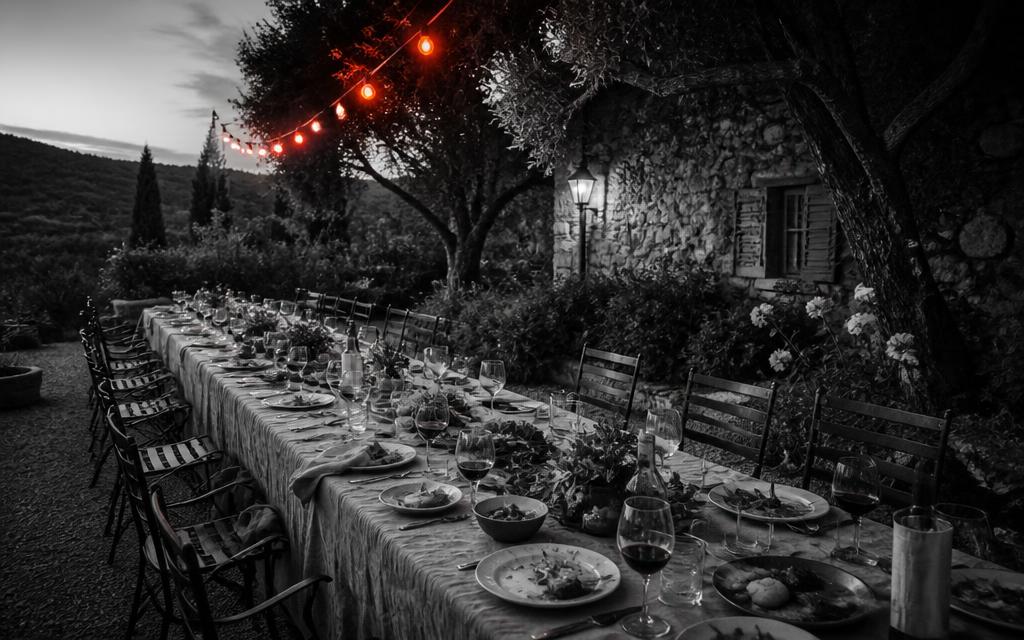
This summer, I spent several weeks in Provence again. Sunshine, old stone houses, tiny French villages, long dinners outside, friends, family, beautiful landscapes — and I got married there. In the language of our time, the whole thing was almost absurdly Instagrammable.
A few years ago, I probably would have turned half of it into content. I would have taken endless photos, filmed little scenes, selected the best shots, edited them, thought about captions, wondered what to post and when, and probably started planning the online version of a beautiful evening before the evening itself was even over. I would have looked at the light, the table, the food, the dress, the scenery and, somewhere in the back of my mind, there would always have been that additional question: How will this look online? And once I had posted it, the next part would have begun. Who reacted? How many likes did it get? Why did this post perform worse than the last one? Who commented? Should I reply? Should I post something else later? What looked like sharing a lovely moment was, in reality, often the beginning of a small media production.
Today, I no longer do any of that. And the longer I live without social media, the more I realize that what I have gained is much bigger than the time I used to spend on Instagram and similar platforms. I have regained a certain way of experiencing my own life.
THE INVISIBLE AUDIENCE AT YOUR TABLE
The real influence of social media does not begin when we open an app. It often begins much earlier. Once you have spent enough years on social platforms, you start developing a second way of looking at your life. Alongside the actual experience of something, another thought quietly appears: Could I make something out of this? A meal is no longer just a meal. A trip is no longer just a trip. A stage, a hotel, a sunset, a new dress, a dinner with friends, a book on the table — everything can become material. Suddenly, an invisible audience is sitting at the table with you, even though nobody else is actually there. This may be one of the most subtle things social media has done to us: it has taught us to experience ourselves from the outside. We are living the moment, but at the same time we are watching ourselves living it.
FROM EXPERIENCING TO PRODUCING
The strange thing is that posting itself can look so harmless. You take a photo, upload it, move on. But anyone who has done this intensively for years knows how much more is involved. You take several pictures because one might not be good enough. Then you choose, crop, edit, write, rewrite, perhaps add music, perhaps decide that it should be a Story instead of a post. Then you publish it and start checking what happened. Who saw it? Who liked it? Why did somebody else's completely ordinary post get ten times more attention? Should you respond to comments? Do you need to post again tomorrow? A beautiful experience gets transformed into a tiny performance project.
And all of this would perhaps be easier to justify if there were a meaningful return. For someone whose job is literally to create content, build reach and sell attention, this is work. But for millions of other people, the reward is mainly attention itself: a few hearts, some reactions, a brief feeling of being seen. We invest real hours of our lives in virtual approval, and most of that approval disappears from our emotional system almost immediately — a mechanism I unpack in "What Is This Dopamine Thing Anyway?".
THE QUESTION THAT SIMPLY DISAPPEARED
Since leaving social media, one question has almost completely disappeared from my everyday life: Should I post this? That sounds trivial, but it changes more than you might expect. I do not have to document a speaking engagement for it to count. I do not need to show anyone where I am travelling in order to enjoy being there. I do not have to publish a beautiful dinner, a great hotel, a sunset, a dress, a conversation or a holiday. I do not have to provide evidence that I am having a good time. Experiences are allowed to be experiences again. I can sit somewhere, talk, eat, drink, laugh, listen, look around and simply stay where I am. Nobody else has to be invited into that moment through a screen. There is something deeply relaxing about that, and it is the kind of freedom you often only notice once you have had it back for a while — one of the quieter items on the list of what actually happens when you quit social media.
NO PHOTO IS NOT A FAILURE. SOMETIMES IT'S PROOF OF PRESENCE.
Something else happened to me several times this summer. We had wonderful evenings with people we love, or with people we had just met, and only afterwards did I realize that I had not taken a single photo. A few years ago, I probably would have been annoyed. Now I almost love it. Because apparently I was too busy being there. I was listening, talking, laughing, eating, drinking, enjoying the evening, and the thought of pulling out my phone simply never occurred to me. Maybe not having a photo is not always a failure to document something. Maybe sometimes it is proof of presence.
We have become so accustomed to recording our lives that an experience can almost feel incomplete if no image exists afterwards. But of course a conversation still happened if nobody filmed it. We still laughed if there is no Story. We still hugged someone if there is no picture in a cloud somewhere. Life does not need digital evidence.
PHOTOS AS MEMORIES, NOT PUBLISHING PROJECTS
I still take photos, of course. I love photos. But their meaning has changed. Many of them remain on my phone. Some I send to family or friends. Some I rediscover months later and smile. Many disappear somewhere among thousands of other pictures, and that is perfectly fine. Photos have gone back to being memories instead of publishing projects. In the past, a photo often created another task. Today, I take the picture, put my phone away and carry on with my life. It sounds almost ridiculously simple, and yet it feels luxurious.
The same is true of privacy. We have become strangely accustomed to the idea that if something is beautiful, important, funny, moving or special, it should be shared. But why? Why does a restaurant visit need an audience? Why a holiday? A birthday? A new job? A gift? A wonderful afternoon? Why should happiness automatically become public information?
WHEN "PRIVATE" STARTED SOUNDING SUSPICIOUS
There was a time when the word private did not sound like something was missing. Today, people sometimes react to things that were never posted as if they somehow happened off the record. Why didn't you share that? Why didn't you post anything? As though an experience only becomes fully real once other people know about it — the same reflex I describe in "The New Digital Proof of Existence". I increasingly feel the opposite. There is something valuable about a moment belonging only to the people who were there. A conversation stays in the room in which it happened. An evening fades into memory without being turned into an online performance. A happy moment remains yours. That can feel intimate in the best possible sense, and it can also feel surprisingly human.
THE DISPLAY WINDOW WE KEEP REARRANGING
Social media is built around showing ourselves, so of course we do. But we almost never show ourselves completely. We select, frame and curate. We decide which version of our life other people get to see, and over time that can turn our lives into display windows that constantly need rearranging. What do I put in there? How does it look from the outside? Is it interesting enough? Is anyone watching? At some point, without really noticing, we can end up working on our public image while supposedly relaxing.
Perhaps that is also why leaving social media can feel strange at first. Suddenly there is nobody to perform for. No feed, no audience, no likes, no algorithm waiting for new material. At first, that absence can feel empty. Later, it can feel incredibly full. What that first stretch actually looks like is mapped out in "The Great Withdrawal: 5 Hours, 5 Steps".
ATTENTION IS THE REAL CURRENCY
The real currency of social media has never been money. It is attention — our attention — and it is finite. Every minute spent constructing the perfect post is a minute we cannot spend elsewhere. Every thought about how something might look online takes a little attention away from the thing itself. Every quick check to see whether somebody reacted interrupts whatever had our focus before. Life does not need to become one long mindfulness exercise, and nobody needs to stare soulfully at every cup of coffee. But it is worth asking what we are spending our attention on, because ultimately our lives are made of exactly that: the things we pay attention to.
A SUMMER ALMOST NOBODY SAW
I experienced many beautiful things this summer. I got married. I spent time with people I care about. I sat outside late into the night, ate exceptionally well, drank too much rosé, laughed, talked, celebrated and enjoyed Provence. And almost nobody outside that circle saw any of it. A few years ago, that might have felt strange. Today, that is part of what made it feel so good. I did not have to turn my summer into a story for other people. I was simply allowed to have it.
Get out of the feed. Really out.
Perhaps that is one of the most liberating lessons of leaving social media behind: something can be wonderful even if nobody is watching. Happiness does not need a feed. And some of the moments for which we have no photo at all may be the moments in which we were most fully there.
That is exactly what my book "QUIT THE FEED! Social Media Is Like Smoking" is about — not "use it a little less", but the bigger question of what happens when you leave for good. And if you want to understand why the feed itself is structurally incapable of ever being empty, read Why Your Feed Is Never Allowed to Be Empty. And what a network could look like that makes connection possible without an audience: What If Social Media Were Actually Social Again?
By Henriette Hochstein-Frädrich · Author of Quit the Feed!