"I Need It for My Business" — and 14 Other Lies We Tell Ourselves
Every social media addict has a story. It sounds reasonable, even strategic. It is, in almost every case, a fairy tale we tell ourselves to avoid quitting.
Every social media addict has a script. It sounds reasonable. It sounds strategic. It sounds, often, a little noble. And in almost every case it is a fairy tale we tell ourselves so we do not have to quit. This is a forensic look at the fifteen most common lies — the polite, professional, perfectly logical sentences that keep us inside a system we already know is hurting us.
We already know. We know the platforms annoy us, stress us, and drain us. We have read the studies. We have felt the symptoms. We have watched our attention shred itself one reel at a time. And still we stay. Why?
Because the system does not only run on algorithms and dopamine. It runs on narratives. On small, friendly, logical-sounding sentences we have repeated so often they now sound like truth. "I need it for my business." "I just want to stay informed." "Just a quick check." Harmless. Reasonable. A valid excuse.
In reality, they are cigarette excuses in digital clothing. Back at the smoking corner: "Oh, I only smoke when I drink." Today: "I'm only on LinkedIn, professionally." Same script. Just with Wi-Fi, and without the smell.
The Lies Are Not Yours
Here is the insidious part: these excuses are not your invention. They are part of the system. They were whispered to you by platforms, by coaches, by ads, by your environment. They are mantras designed to keep you running in the hamster wheel: Stay in. Stay visible. Stay reachable. Stay dependent. And eventually, you believe it. You convince yourself you would lose something real if you left — clients, friends, information, relevance, connection.
The truth? Most of the time, the only thing you actually lose when you leave is chronic stress, comparison addiction, and pixel prestige. The system is clever. It sells your dependency as necessity. It makes you believe that without it, you are invisible, uninformed, irrelevant. That is a bluff. A smoke screen. As the parallels to Big Tobacco have made painfully clear, the business model needs your insecurity more than your loyalty.
No one on their deathbed will say: "If only I had posted more stories."
So let's clean house. Fifteen lies, dismantled one by one.
1. "I Need It for My Business."
The professional-grade self-deception. Sounds important — visibility, brand, relevance. Hand on heart: how much real revenue, traceable to a line item, came from your last hundred hours of scrolling? How many of your best clients came through TikTok? And how many hours per week do you burn appearing on LinkedIn as if you were dominating your industry, while your actual product, your real work, sits on hold?
Presence does not replace excellence. Many of the people who believe they "need" social media for their business actually need something else entirely: a clearer strategy. A better product. The courage to approach real people directly instead of begging the algorithm for reach. Ask yourself honestly — are you working on your business, or just on your image? Are you building substance, or a façade?
The bitter truth: social media does not automatically make you visible. First, it makes you interchangeable. You end up wedged between selfie coaches, fake gurus, and Canva motivational quotes. The genuinely relevant people are rarely the ones posting 24/7. They are the ones moving something without having to prove it constantly.
2. "I'm Only Staying for the Inspiration."
The noblest excuse of all. Just checking what others are doing. Purely creative input. Thirty-seven minutes later you are deep in an interior-design vortex, watching someone decorate cakes you will never bake.
Inspired? More like deflated. What looks like creative training is cheap mental junk food. Beautifully staged, easy to digest, zero nutritional value. The more you "get inspired," the less you find your own style. The less you actually create. This kind of inspiration doesn't wake the muse — it kills her. Your synapses are so overfed with other people's images there is no space left for your own.
Real ideas don't arrive while scrolling. They arrive on a walk. In the shower. In the idle mode of your brain — where there is silence, where there is boredom, where your mind is finally allowed to work instead of functioning as a content conveyor belt. Inspiration is a spark. Creativity is the fire. And fires do not grow by stealing other people's sparks.
3. "I'm Just Networking."
With 2,439 followers. How many of them have you spoken to in the past year? How many have you actually met for coffee?
Social media sells us the fairy tale of grand connectedness. What it delivers are digital file cards. A like is not a conversation. A follower is not a relationship. A DM is not genuine interest. We collect contacts like Pokémon and forget that it isn't about quantity but quality. We feel connected while we are really just performing connection.
And the absurd part: while we spend hours "networking," we miss real encounters. Those don't happen by typing. They happen by listening, by meeting, by making the damn phone call. A network made only of clicks will support you in a crisis about as well as a paper boat in the ocean.
4. "But You Have To Be Visible!"
Visible for what? For whom? At what price? If everyone is shouting "Here!", who is still listening?
Being visible does not automatically mean being noticed. Certainly not respected. Many of the people you see every day have nothing to offer except volume. Noise is not impact. Reach is not relevance.
The real questions: do you want to be visible — or do you want to be felt? Do you want reach — or resonance? Do you want to be a flashing billboard — or a thought that lingers? Real impact comes from depth, clarity, and presence at the right moment, on the right stage. Often, that stage is not the feed at all. It is in your clients' minds, in their decisions, in their trust. No algorithm can access those rooms.
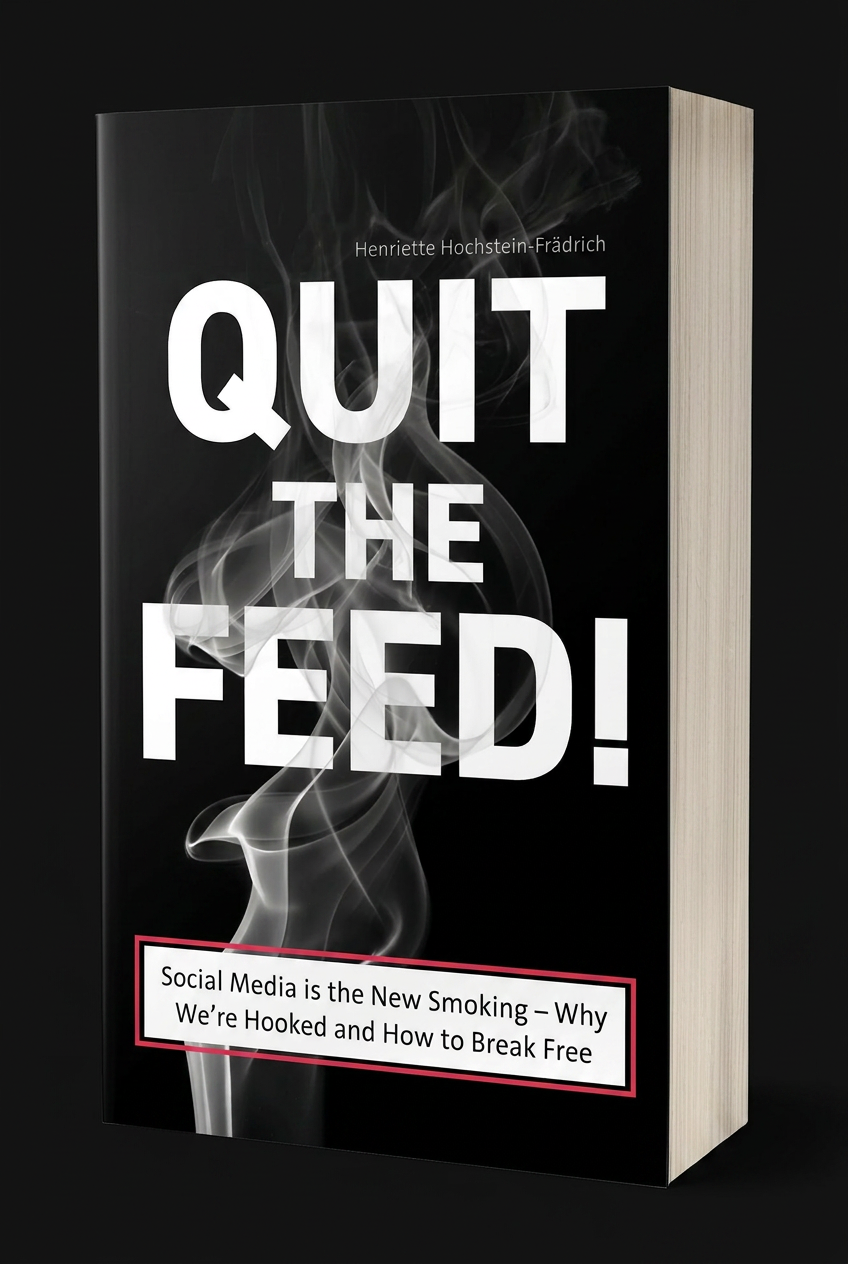
Every excuse, dismantled.
Part Two of Quit the Feed! is the radical demystification. Fifteen lies the system tells you — taken apart in full, with the psychology behind why we believe them and the language you need to step out without losing yourself.
Read the book →5. "But I Need to Know What My Friends Are Up To."
Wouldn't you know much better if you called them?
We confuse information with connection. We stare instead of talk. Real closeness does not come from scrolling through your friends' selfies. It comes from sitting on a couch together. From sharing a pizza. From silence and laughter and actual exchange.
Often "I just want to see what they're up to" is nothing more than light voyeurism. We call it closeness. In reality it is watching. And watching rarely makes you happy. You see their vacation and feel bad you are not at the beach. You see their fitness selfie and your stomach feels softer. You see their living room and yours feels like a storage closet. Friendship is not a subscription model. It needs one thing: you, in real life, in real contact.
6. "But I Have to Stay Informed."
Are you informed — or overwhelmed? Scrolling is not thinking. Headlines are not a worldview.
Social media is the worst news channel imaginable. It does not show you the world. It shows you the slice most likely to trigger you. Relevance does not decide what reaches you; click potential does. Outrage always wins. Your brain is not receiving information — it is receiving a constant stream of mini-shocks. War, scandal, half-naked bodies, disaster, new meme. You feel busy. At the end of the day you are not smarter, just more stressed.
Being informed does not mean knowing everything. It means distinguishing what matters from noise. That is precisely what social media cannot do — it is built to drown you in noise. If you really want to stay informed: read a newspaper. Listen to a long-form radio feature. Talk to people who actually know something. Stop pretending your feed is an education.
7. "Otherwise I'll Lose Touch."
Lose touch with what — the next viral reel?
FOMO is the most perfidious business model social media ever built. It survives by whispering: "Stay here, or you're out." Out of what, exactly? A 48-hour shitstorm? An endless debate that will be forgotten next week and was staged to begin with?
If you are offline for a few days, you lose nothing. You gain. You gain quiet, time, and focus. The only thing you actually "miss" are pixel debates that change nothing in your real life. Connection to the world does not mean being online 24/7. It means being present where it counts. Big things always find their way to you. The far greater danger is not losing touch with the world. It is losing yourself in the noise.
8. "I Just Want to Check Quickly."
Spoiler: the system knows how to turn 30 seconds into 30 minutes. The house always wins.
Just one reel. Just the news. And boom — 37 minutes later you are still there. Square eyes, numb fingers, a head full of other people's thoughts you never ordered. Social media is not a harmless visit. It is a slot machine. You pull the lever — a like, a meme, a scandal — hoping for the big hit. What you actually get is the digital alchemy of the 21st century: your precious time turned into lost time.
You realize it only when it is too late. You put the phone down, look at the clock, and ask: "What just happened?" Answer: nothing. Except that you let yourself be robbed of another piece of your lifetime. There is no "just a quick check." There are only two options: you step in, or you step out. And if you step in, the system wins.
9. "I Need It to Relax."
The classic smoker's excuse, in digital clothing.
Back then: "Oh, I just need a cigarette to unwind." Today: "I'm just scrolling a bit to relax." Sounds like a break. It is the opposite. Your nervous system rides a roller coaster. Your dopamine plays pinball. Your cortisol does the cha-cha. That is not winding down. That is a full-speed brain trip.
We constantly confuse two things: distraction and relaxation. Distraction numbs. Relaxation heals. Distraction feels like relaxation at first because it pushes your thoughts away — but they are not gone. They wait in the background until the feed ends, and then they hit twice as hard. Real relaxation is a walk. A deep breath. A conversation. A nap. Social media is an energy drink on an empty stomach.
10. "I Need to Stay on Top of My Industry."
The business-class version of "I need to stay informed."
A favorite among freelancers, coaches, and creatives — as if LinkedIn or Instagram were sacred oracles whispering tomorrow's trends. Spoiler: they are not. What they give you is an echo chamber. The same people saying the same things, wrapped in a fresh Canva design. "Future of Work!" "New Leadership!" "AI is the future!" Thank you, Captain Obvious.
The illusion: you are staying informed. The reality: you are staying in the loop. You read the same buzzwords a hundred times and assume your knowledge has deepened. It has just been spread thinner. If you actually want to know what is happening in your industry — read a study, read a book, read a trade journal, talk to an expert, go to a conference, call a client. LinkedIn is not an industry radar. It is a self-marketing circus where the loudest clowns look like the brightest minds.
11. "I Just Want to Share Something Good and Inspire Others."
The halo among excuses. You are not addicted, you are a digital philanthropist.
The unfiltered truth: most "inspirational posts" are self-presentation dressed in an altruism costume. The perfectly chosen filter, the hour of hashtag research, the accidentally super-authentic sunset selfie — none of that has anything to do with serving humanity. Good deed + likes = dopamine jackpot. The platforms know this. They live off it.
It is not about inspiring. It is about validating. Which is fine, if you admit it. But stop pretending you are saving the world while you are really just feeding your ego. If you genuinely want to do something good: put the phone down and do it. Call someone. Donate. Hug your child for two uninterrupted hours. Everything that truly inspires happens offline. It does not need hashtags.
12. "I Don't Want to Disappoint My Community."
How touching. So you are basically serving humanity. Your community is desperately waiting for your next reel.
Bullshit. Most people will not notice if you stop posting for weeks. The algorithm filters you out most of the time anyway. Your "community" sees a fraction of what you publish. And the ones who do notice when you go quiet? Those are the people genuinely interested in you. They will still be there without daily stories.
The uncomfortable truth behind this excuse: it is not about disappointing anyone. It is about the fact that you cannot sustain your self-performance. You are afraid the house of cards you built on constant presence will collapse if you stop delivering. "My community needs me" sounds nobler than "I need my dopamine hit." Nobody has ever died because you went offline for a week.
13. "But It's Free!"
The most naïve excuse of all. No price tag, therefore no danger.
You are paying. You are paying dearly. Not with money — that would actually be harmless. You are paying with your time, your attention, your data, and your self-worth. "Free" in this case means one thing: you are not the customer, you are the product. The platforms sell you — your clicks, your preferences, your emotions — packaged into neat user profiles and auctioned off every second.
Your boredom is their business model. Your scrolling finger is their printing press. Social media is only free for you. For advertisers, it is extremely expensive. They buy you for billions. The invisible invoice does not arrive in your mailbox; it shows up as exhaustion, restlessness, and a constant feeling of distraction.
14. "I Just Want to Preserve My Memories."
Sounds innocent. Almost romantic. As if you were the digital family album of your own life.
Are you really doing it for yourself? Or are you already living more for the photo than for the moment? When you stage your life through a lens, you are not inside it. You become the cameraman of your own everyday life. You post the sunset and miss seeing it. You film your child laughing but do not laugh along.
Studies show people remember events worse when they constantly photograph them. Your brain decides: "Got it. There's a photo. No need to store this." You outsource your memories to the algorithm. Years later you scroll through your archive and think: "Ah, that was beautiful." But you feel nothing — because you did not really feel it back then either. You were too busy producing content.
15. "Everyone Else Is There Too."
The pure logic of the schoolyard. "Everyone's smoking, so I smoke too." "Everyone's on TikTok, so I have to be too."
This excuse sounds like social intelligence — "I'm adapting" — but it is naked fear. Fear of not belonging. Fear of looking uncool. That is exactly where the system presses hardest. "Everyone is here, so you should be too." That is not a social network. It is a schoolyard mob with nice UX.
Do you really want to base your life on what "everyone else" is doing? Everyone else also spends hours watching reels, procrastinating their to-do lists, and feeling dissatisfied. Everyone else is not a benchmark. They are the excuse that lets you avoid deciding for yourself. And the painful part: everyone else would not even notice if you left. Freedom begins the moment you dare to do exactly what everyone else is not.
Enough With the Self-Deception
None of these fifteen sentences are truths. They are narratives. Stories the system whispers and we happily repeat — because they save us from something uncomfortable: facing our own dependence.
As long as we keep telling ourselves these stories, we stay trapped. Which leads to the only honest conclusion of this essay: the biggest obstacle to your exit is not the platforms. It is you. Your stories. Your justifications. Your excuses. And the moment you can hear them clearly — the moment you can say "that's not even true" — the spell breaks.
That is the prerequisite for everything that comes next. Once the lies are exposed, the exit becomes a matter of protocol, not willpower. What that protocol looks like — the five hours, the five steps, the first day, first week, first six months — is the subject of the next essay: The Great Withdrawal: 5 Hours, 5 Steps. If you would rather start with the four-step field guide for what to actually do — the diagnostic, the real decision, the replacement work — read How to Deal With Social Media Addiction. And if you have not yet read the diagnosis that started this whole argument — why the addiction works at all — start here: Social Media is the New Smoking. And if you want to understand why the feed itself is structurally designed to keep refilling even after you try to clear it out, read Why Your Feed Is Never Allowed to Be Empty.
Nothing holds you tighter than a lie you believe to be true. And nothing sets you freer than the moment you stop believing it.
By Henriette Hochstein-Frädrich · Author of Quit the Feed!