The Great Withdrawal: 5 Hours, 5 Steps — A Protocol for Leaving
Not a digital detox. Not a weekend offline. A structured exit modeled on a proven recovery principle: understand, unlearn, transform. Here is the first hour.

Quitting social media is not a willpower problem. Smokers locked in a room full of ashtrays do not quit by trying harder. They quit when the system around them changes — when the cigarettes are gone, the cues are gone, and the story they tell themselves about smoking finally collapses. The same logic applies to the feed. The intervention has to be structural. It has to happen in the right order. And it does not take thirty days. It takes five hours.
This is not a digital detox. Detox is a wellness word. It implies a weekend, a juice cleanse, a self-congratulatory Instagram post on Sunday night about how refreshed you feel before you reopen the app on Monday morning. That is not what this is. This is an exit. A clean one. The kind you do once, not the kind you negotiate with yourself every Sunday.
How to Quit Social Media Isn't a "Detox" — It's Withdrawal
The word detox has done enormous damage to the conversation about leaving social media. It frames the problem as a temporary buildup of toxins that a little rest will flush out. As if the feed were a glass of wine too many and Monday morning would solve it. It will not. The feed is not a toxin you can sweat out over a quiet weekend. It is a habit your nervous system has rehearsed thousands of times, in thousands of small moments, across years. You cannot sleep that off.
The romanticized detox model also has a built-in escape hatch: the assumption that you will return. A detox is, by definition, temporary. You drink less for a week so you can drink again. You leave Instagram for five days so you can come back rested. The whole frame protects the addiction. It says: this is not a problem, this is just a phase you cycle through. That is exactly the story the platforms want you to tell yourself, because it guarantees your return.
Anyone who has read the diagnosis essay Social Media is the New Smoking knows where this leads. You cannot detox from a behavioral addiction by taking a short break from it. You can only stop. And before you can stop, you have to see clearly through the stories that keep you in — the topic of "I Need It for My Business" and 14 Other Lies. Once those two pieces are in place — the diagnosis and the deconstruction — what remains is the act itself. The protocol.
Why Five Hours, Not Thirty Days
The longer the program, the lower the completion rate. This is one of the most reliable findings in behavior change research, and it is the reason most thirty-day digital detox challenges quietly collapse around day eleven. A long program gives the addiction a thousand small openings: bad mood, hard week, social event, vacation, "just this once." Each opening is a relapse. Each relapse is a reset. After enough resets, the person concludes that they are weak, when in fact the program was simply badly designed.
The five-hour structure is borrowed, in spirit, from Allen Carr's The Easy Way to Stop Smoking — a method that has helped millions of people put down cigarettes not by gritting their teeth, but by changing what they understood about smoking until the craving no longer made sense. The point is not duration. The point is that the change happens in a single, concentrated act. You sit down, you walk through the steps in order, and at the end you are out. Not negotiating an exit. Out.
The five hours do not have to be five consecutive hours. They can be five focused sittings spread across two days. What matters is the sequence and the commitment to finish it. Skip a step and the structure collapses. Reorder them and you end up with another well-intentioned weekend that quietly ends on Tuesday.
How to Quit Social Media in 5 Hours: The Roadmap
Before going into each hour, here is the whole shape, so you know where you are going:
- Hour 1 — Laying the Mental Foundation. Not an app timer. An inner stance. Why you really want out, and what you are reclaiming.
- Hour 2 — The Moment of Liberation. The internal shift from I have to to I want to. The moment the cage opens from the inside.
- Hour 3 — The Live Scroll Protocol. One final, fully conscious session inside the feed. Forensic, not nostalgic.
- Hour 4 — The Cut. Logout. Uninstall. Delete the account. Not deactivate. Delete.
- Hour 5 — The First Hour After. The withdrawal itself. Sixty quiet minutes that decide the next year of your life.
What follows is the headline version of each hour. The full version — with the exact reflection prompts, the scripts for the harder moments, the protocol for the first week and the first month, and the guidance for the inevitable wobble around day four — is in the book.
Hour 1 — Laying the Mental Foundation
What you need before anything else is not an app blocker. It is an inner stance. The reason most exits fail is that they begin as a reaction — a bad night of sleep, a frustrating evening of doomscrolling, a flash of self-disgust — and the underlying conviction never solidifies. Reactions fade. Convictions hold.
The foundation of the entire withdrawal is one psychological shift: you are not giving up anything. You are taking back something. Time. Attention. Sleep. The capacity to be bored. The ability to sit through an unanswered moment without reaching for a phone. The feed did not gift you these things and then graciously let you keep them. It quietly billed your account, day after day, for years.
A simple, almost embarrassingly low-tech exercise begins here: a sheet of paper, by hand, with two columns. On the left, three specific things the feed has taken from you in the last year. Not abstract — specific. A night of sleep. A conversation you cut short. A project you never finished. On the right, three things you intend to reclaim. Not virtues, not slogans, real things: a morning without a screen, a book finished, an hour with one other human being who has your full attention. Read it aloud when you are done. This becomes your reference document for the week ahead, when nostalgia starts whispering that it really wasn't so bad.
The longer guided version of Hour 1 — the deeper reflection prompts, the work on the specific emotional hooks each platform has set in you, and the inventory of the cues you need to disarm in your environment — is in the book.
Hour 2 — The Moment of Liberation
Every successful exit, from any addiction, contains a single moment that observers miss and the person themselves rarely talks about: the moment when the inner sentence changes from I have to stop to I do not want this anymore. The first is compulsion. The second is freedom. They sound similar from the outside. They are completely different on the inside.
You cannot force this moment, but you can prepare the ground for it. It tends to arrive when two things line up: a clear-eyed view of what the feed actually does to you (the diagnosis), and a clear-eyed view of the stories you have used to justify staying (the deconstruction). When both are honest, the moment tends to arrive on its own. You catch yourself opening an app and, for the first time, the gesture looks ridiculous from the inside. The thumb moves and the brain notices. That noticing is the moment.
One useful trigger: close your eyes for sixty seconds and picture, in concrete sensory detail, what an ordinary Tuesday evening looks like one year from now if nothing changes — same feed, same loops, same nightly scroll into sleep. Then picture the same Tuesday evening if you make the cut today. Most people do not need a third minute. The body answers before the mind does.
The Full Five-Hour Protocol
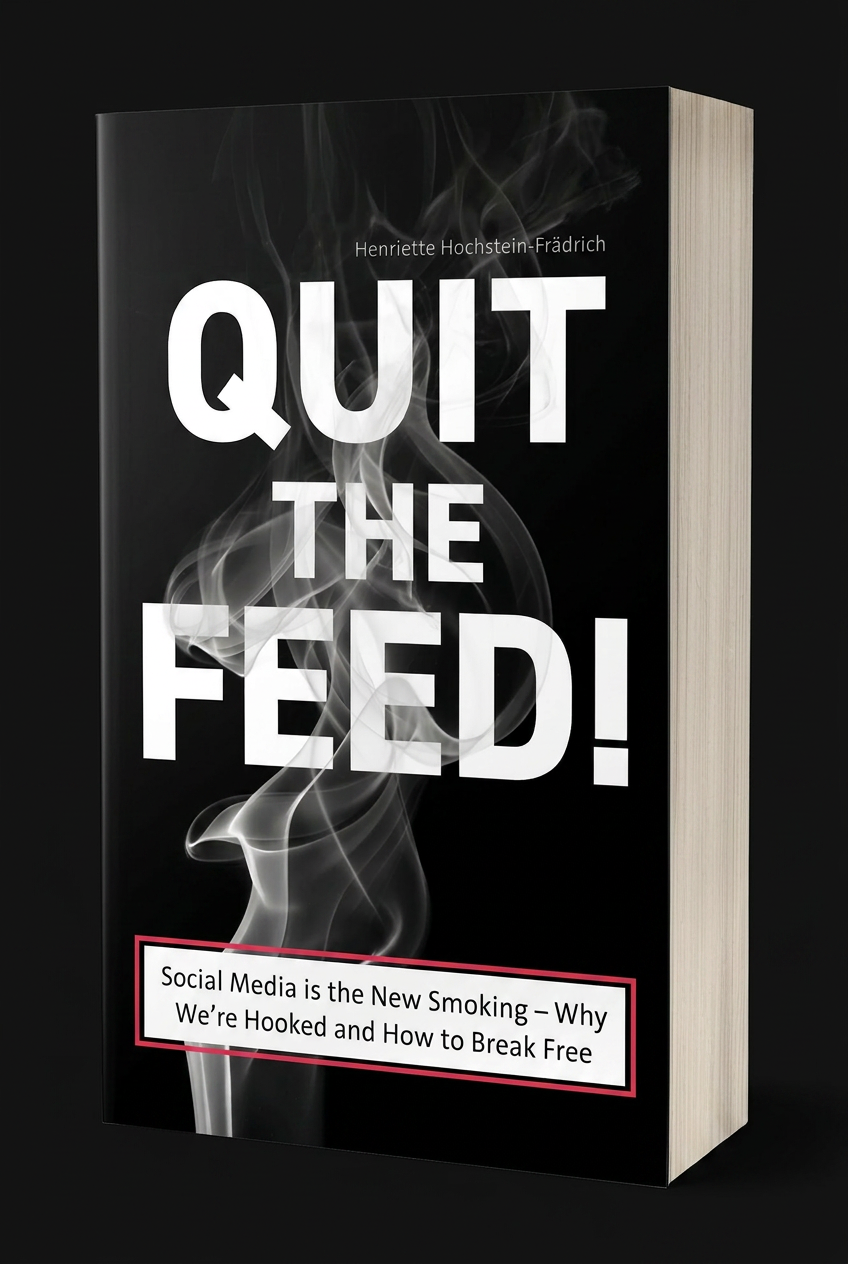
This essay is the map. Quit the Feed! is the guided walk — every reflection prompt, every script for the hard moments, the full Live Scroll Protocol, the first-week and first-month companion, the relapse-proofing toolkit. Written by someone who walked it. Designed so you can walk it once and never need to walk it again.
Read the book →Hour 3 — The Live Scroll Protocol
In Carr's smoking seminars, participants are required to smoke a final cigarette — after they have already understood, in detail, what the cigarette does to them. By that point most people do not even want it. That is precisely the point. The same principle applies here. Before you delete anything, you take one final, fully conscious pass through the feed. Not a casual goodbye. A forensic one.
The headline version, in three movements:
- Set a tight window. Fifteen to thirty minutes. Timer on the table. Pen and paper next to it — analog, because writing by hand processes more deeply than typing.
- Observe, do not consume. Open the app and say it out loud: this is my last session, I am observing, not consuming. Then watch what the feed actually does. Note the repetitions. Note the ads. Note what each piece of content does to your body — heart rate, breath, the small dopamine flickers, the comparisons, the boredom dressed up as interest.
- Write the verdict. When the timer ends, read your notes back and write one honest sentence: this is why I am out. That sentence is the receipt. Keep it where you can find it on day four.
What happens, almost universally, is that the magic of the feed dissolves under observation. The thing that seemed essential becomes obviously hollow. The "fear of missing out" quietly becomes "this is what I was so afraid of missing?" That shift is the point of Hour 3. The full Live Scroll Protocol — with the exact observation grid, the prompts for each platform, and the closing ritual — is in the book.
Hour 4 — The Cut
This is the hour where thinking ends and acting begins. And it is the step where almost every well-meaning attempt gets quietly sabotaged, because almost everyone tries to do a Soft Cut and call it an exit. It is not.
The Soft Cut: log out on all devices, uninstall the apps, turn off notifications, hide the icons. This is genuinely useful — but it is the equivalent of leaving an open pack of cigarettes in the kitchen cupboard. The password is still saved. The account is still alive. Reinstalling takes thirty seconds. You are one bad evening away from being back inside.
The Hard Cut: delete the accounts. Not deactivate. Not "take a break." Delete. Yes, you lose the follower count. Yes, the content disappears. Yes, the platform makes the process deliberately uncomfortable, walks you through guilt-tinged warning screens, reminds you of the friends who will "miss you." That entire flow is designed to keep you in. Smile at it. Click through it. The reason the Hard Cut is so much more powerful than the Soft Cut is psychological, not technical: when you log out, you are someone on a break. When you delete, you are someone who is out. Only the second person is actually free.
Most platforms keep a grace window of around thirty days before the deletion becomes irreversible. That is a safety net, not an invitation. The whole point of the Hard Cut is that the option to "just check" no longer exists. You closed the door from the outside.
One sentence helps in this hour. Write it down, on the same sheet as the Hour 1 reclamation list, and read it before you click each delete button: "Just one quick look" is never just one. I deleted it. I am free."
Hour 5 — The First Hour After
And then: silence. The icons are gone. The accounts are gone. Your thumb, on its own, slides toward where the app used to be and finds nothing. This is the actual withdrawal — a sixty-minute stretch in which your nervous system protests politely, then loudly, then quietly accepts that the stimulus is not coming back.
What helps in this hour is almost embarrassingly simple, which is why almost no one prepares for it:
- Give the body something to do. A walk. Stretching. Making a coffee slowly. Anything that puts something in your hands that is not a phone. The reflex is physical first, emotional second.
- Tell one person, out loud. Call a friend. Say the sentence: "I deleted it." Spoken commitment moves the decision out of the private negotiation chamber where addictions live and into the world where they cannot quietly come back.
- Fill the silence on purpose. A book within reach. A notebook open. A piece of music chosen, not algorithmically served. The point is not to distract yourself from the absence. The point is to notice that something else fits into the space.
By the end of Hour 5, the most important proof has been delivered: the world did not collapse. The work emails still arrived. The friends who matter still reached you. The silence turned out to be spacious rather than threatening. You stop being a person trying to quit and start being a person who already did.
What Happens After Hour Five
The five hours are the bridge. They are not the destination. What follows them — the first day, the first week, the first month, the first six months — has its own predictable shape: a sharp clarity in days one to three, a wobble around day four, a strange resurfacing of buried emotions in week two, an almost-relapse around week three, and somewhere around month two the realization that you have stopped thinking about the feed at all. That arc is too long to compress into an essay and too important to wing.
The full companion through those months — the daily check-ins, the relapse-proofing scripts, the prompts for the moments when boredom and grief and old habits all show up at once — is the second half of Quit the Feed!. It is the part that turns the five-hour exit into a permanent change. If this essay landed, that is the next step.
How to Break Social Media Addiction — The Short Version
If you have landed here looking for the shortest honest answer to how to break social media addiction, it is this: stop treating it as a willpower problem and start treating it as a structural one. See the behaviour for what it is (an addiction, not a habit). See through the stories you use to justify it. Run the five-hour protocol above in order — foundation, liberation, live scroll, the hard cut, the first hour after. Then let the predictable arc of the first weeks do the rest. That is the whole method. Everything else is detail.
Leaving Is Not the Hard Part
The hard part is the believing. Believing that you are not losing anything. Believing that the silence on the other side of the cut is friendlier than the noise on this side. Believing that you, specifically, are allowed to do this — not in three months, not after the next launch, not once life calms down, but now.
The protocol does not make the exit possible. The exit was always possible. The protocol just removes the excuses, one by one, in the right order, until what is left is the obvious move. Five hours. Five steps. And on the other side, a life that is no longer dictated, twenty-four hours a day, by an algorithm that was never on your side.
If you have not yet read the diagnosis that this whole protocol rests on, start here: Social Media is the New Smoking. If you are not yet sure whether you want a clean exit or just a clean pause, the staircase from one to the other is here: Social Media Break: How to Take One (or Quit for Good). If you suspect the reasons you tell yourself for staying are not as solid as they sound, read this next: "I Need It for My Business" — and 14 Other Lies We Tell Ourselves. And when you are ready for the guided exit itself — the full five hours, the first week, the first six months — the book is waiting: Quit the Feed!
And if you want to zoom out from the protocol to the bigger picture — why doing this at all is quietly becoming a cultural movement, in the same lineage as sugar-free and sober-curious — read Quitting Social Media is the New Sugar-Free.
Welcome to the other side.
By Henriette Hochstein-Frädrich · Author of Quit the Feed!