What Even Is This Dopamine Everyone Keeps Talking About?
Dopamine is not happiness. Dopamine is: "Go on. Do that again." Why "dopamine detox" is scientifically nonsense — and still hits the most tender nerve of our time. A deep dive for anyone who wants to understand why social media is so damn sticky.
Dopamine is not happiness. Dopamine is: "Go on. Do that again." Why "dopamine detox" is scientifically pretty much nonsense — and still points at something very real. A deep dive into the messenger molecule everyone is suddenly talking about, often without really knowing what it does. Required reading if you want to understand why social media is so ridiculously hard to put down.
The other day my sister Nina wrote to me. She had read my book Quit the Feed! — attentively, critically, with that loving but ruthlessly precise gaze only sisters have, the kind that makes you think at the exact same time: "thank you for your feedback" and "could you please be a little less right?" Her note went roughly like this: "Henriette, you keep writing about dopamine. Dopamine kick, dopamine system, dopamine trap. But at some point I found myself wondering — what actually is dopamine? I would have liked more there." Caught. Because yes, I do explain dopamine in the book, but more in the party way: "oh, that's this messenger substance that makes us addicted," everyone nods, nobody asks follow-up questions, and we all go back to the cheese board. Not enough. So, dear Nina — and dear everyone else who has politely wondered the same thing — here it is. The dopamine deep dive. Not a medical lecture with comatose synapses, but an attempt to make sense of why everyone is suddenly talking about dopamine, and why the topic is much bigger than a wellness trend called "dopamine detox." Because if we want to understand social media, we have to understand dopamine. No, dopamine does not explain everything. But without dopamine, quite a lot becomes very hard to explain.
Dopamine Is Not Happiness. Dopamine Is: "Go on. Do that again."
Let's start with the biggest misunderstanding. Dopamine is often called the "happiness hormone," which sounds lovely and harmless, like a lavender bath, chocolate and a romantic comedy. But that is not quite right. Dopamine is not a simple happiness juice trickling through your brain whenever something nice happens. It is more like a neurochemical motivation manager, an inner driver, a signal that tells your brain: attention — this matters, remember this, go there again, do it again. So yes, dopamine has a lot to do with reward. But even more with expectation, desire, learning and motivation. It is not only about something feeling good. It is about your brain learning: this could be worth it. Food, sex, social connection, discovery, recognition, a new message, a red notification badge — all of it gets tagged "potentially important," and dopamine is the tag.
Dopamine helps us respond to opportunity. It gets us up, makes us search, want, pursue, explore. Without it we probably would not wake up in the morning thinking "today I am going to build a life"; we would just lie there like sad pancakes asking what the point is, anyway. We need dopamine to move, to learn, to plan, to want, to keep going, to love, to live. The problem is not dopamine. The problem is what modern systems do to our dopamine.
Once Upon a Time: Berries. Today: the Endless Feed.
Our brain is old. Very old. It was not built for TikTok, push notifications, 173 WhatsApp groups, algorithmically optimised reels, food delivery apps or email subject lines screaming "today only." It was built for a world in which rewards were rare. A sweet berry — jackpot. A safe place to sleep — jackpot. A friendly face — jackpot. A new track in the forest, a sign of danger, a friendly face: pay attention. In that world dopamine was brilliant: it helped us recognise what mattered for survival and repeat useful behaviour. The trouble is, we no longer live in a world of scarcity. We live in a world of artificial abundance — stimuli everywhere, options everywhere, tiny little promises everywhere. Maybe there is something important in this message. Maybe someone reacted to your post. Maybe the next reel will be funny. Maybe you are about to be seen, loved, validated, rescued. And that tiny "maybe" is pure dynamite for the reward system.
The Most Dangerous Stimulus Is Not the Reward. It Is the Possibility of a Reward.
This is why social media is so sticky. Not every glance at your phone feels good. Not every reel is funny. Not every message is pleasant — often it is the opposite. And still, we keep reaching. Because our brain does not only respond to reward; it responds to the expectation of reward. Maybe something is waiting there. That uncertainty is the trick. We know the principle from gambling: slot machines don't work because you always win — they work because you win sometimes, unpredictably, irregularly, often enough to stay, rarely enough to keep searching. Social media is basically a slot machine in your pocket. You don't pull a lever; you swipe down. Refresh. Maybe a like, maybe a comment, maybe a message, maybe a scandal, maybe a cute dog video, maybe someone from your past suddenly reappearing. Scrolling is not consumption. Scrolling is search — a search for something you often cannot even name. And dopamine loves search. Dopamine loves novelty. Dopamine loves the feeling that something might be about to happen. That is what makes the feed so viciously clever: it never gives you enough to feel satisfied, but always enough to keep going. Like crisps. For the brain. This is the core of what I describe in Social Media is the New Smoking as addiction by design.
Dopamine Doesn't Make Us Satisfied. Dopamine Makes Us Hungry.
This matters. Dopamine is not the substance of deep contentment — not the warm feeling after a good conversation, not the quiet fulfilment after a day in nature, not the calm joy of having done something meaningful. Dopamine is more like: more. More of this. Again. Continue. Search. Click. Look. Go there. Dopamine is not an armchair you can rest in. It is a trampoline. It makes you jump toward the next thing, again and again and again. That is exactly why social media rarely makes us truly happy. It makes us activated, irritated, awake, expectant, briefly rewarded — and then hungry again. You know that feeling after forty-five minutes of scrolling: not rested, not inspired, not satisfied, just stuffed and empty at the same time. Like after a bag of crisps you didn't even want — except this time it's not your fingers that are greasy, it's your nervous system.
That is the difference between genuine joy and dopamine-driven wanting. Real joy has an ending. It rounds itself off. It fulfils. The dopamine loop stays open. It does not say "lovely, thank you, enough." It says "there is more." And social media replies "of course — here, have another one." That is how you scroll yourself into the great Get-No-More.
Why Dopamine Is Actually Good
Now please don't misunderstand. Dopamine is not the villain. Fighting dopamine would be about as sensible as being against oxygen because some people hyperventilate. Dopamine is wonderful. It helps us pursue goals, makes us curious, helps us learn, gives us drive. Without it there would be no spirit of discovery, no anticipation, no energy to tackle things. Healthy things activate dopamine too:
- Exercise, dancing, sport
- Music, creativity, learning a craft
- Good food, flirting, laughing
- Nature, real connection, a brave step
- A project completed, a conversation where you suddenly think "oh wow, something is happening here"
So dopamine is not the problem. The problem begins when natural, meaningful, embedded rewards are replaced by artificially accelerated, hyper-condensed, permanently available mini-kicks. In the past you usually had to do something for a reward. Today one thumb is enough. That changes everything.
The Dark Side: When the Reward System Gets Hijacked
Our brain is constantly learning — which is fantastic, and also damn inconvenient, because it also learns things that are bad for us. If you always reach for your phone when you are bored, your brain learns boredom = phone. Open Instagram when you are stressed, it learns stress = scrolling. Lonely and TikTok briefly distracts you? Loneliness = feed. Insecure and a like gives relief? Self-worth = external reaction. Every time the track gets a little deeper — not because you are weak, but because your brain is efficient. It remembers what brings short-term relief. Short-term. That is the catch: many dopamine-intense stimuli do not solve the problem, they only cover it. Tired — you scroll. Overwhelmed — you scroll. Sad — you scroll. Bored — you scroll. Insecure — you post. And the brain learns: don't feel, stimulate; don't regulate, distract; don't endure, consume. That is not freedom. That is conditioning.
Social media is not powerful because we are stupid. It is powerful because it taps into very old, very deep human needs — to belong, to be seen, to understand status, to detect danger, to discover novelty, to matter — and amplifies all of them technically. Likes are tiny social signals. Comments are bite-sized recognition snacks. Follower counts are status displays. Stories are windows of belonging. Notifications are attention hooks. Reels are novelty grenades. Algorithms are behavioural amplifiers. The system never asks "what is good for you?" It asks "what keeps you here?" If anger keeps you longer than joy, you get anger. If comparison keeps you longer than contentment, you get comparison. If fear keeps you longer than calm, you get fear. Not because some little algorithm devil sits in a server room going muahaha, but because the business model is built that way: attention in, data out, advertising in between, fat profit on top. The reasonable-sounding stories we tell ourselves while staying trapped in this system are exactly what I dismantle in "I Need It for My Business" — and 14 Other Lies We Tell Ourselves.
Dopamine Detox: What Is That Even Supposed to Mean?
Which brings us to the trend: dopamine detox, sometimes called dopamine fasting. At first it sounds like biohackable self-optimisation with a slightly religious aftertaste — very "today I gave up coffee, sugar, music, conversations, light, joy and eye contact, and now I am finally a better person." The idea is that for a certain period you avoid highly stimulating activities — social media, gaming, pornography, online shopping, junk food, binge-watching, sometimes even music or coffee — so the brain can supposedly "normalise" again. Here we need to be very clear: strictly scientifically, the term dopamine detox is nonsense. You cannot detox from dopamine. Dopamine is not a pollutant. Not tar. Not alcohol. Not a toxic ex you need to smoke out of your nervous system. It is an endogenous messenger substance your body makes and needs. A real dopamine detox would not be enlightenment; it would be a neurological problem. What people usually mean is not "I want less dopamine in my body," but "I don't want to keep reaching for quick stimulation all the time." And that is a very sensible thought. The term is wrong. The need behind it is real.
Why is everyone suddenly talking about dopamine? Because many people feel it: something is off. We are overstimulated and exhausted at the same time. Informed and confused. Connected and lonely. Entertained and empty. Busy and internally restless. We have access to everything and can hardly stay with anything. We can hear every song, contact every person, google every answer, order every product, fill every gap — immediately. Waiting? Difficult. Boredom? Threatening. Silence? Almost suspicious. The dopamine detox trend isn't random; it is a symptom, a collective groan from an overstimulated nervous system. People are not really saying "I want less dopamine." They are saying: I want control over my attention again. I want to feel something that does not disappear immediately. I want to live without constantly triggering myself. Which means dopamine detox is not the solution — it is the clue pointing to the problem.
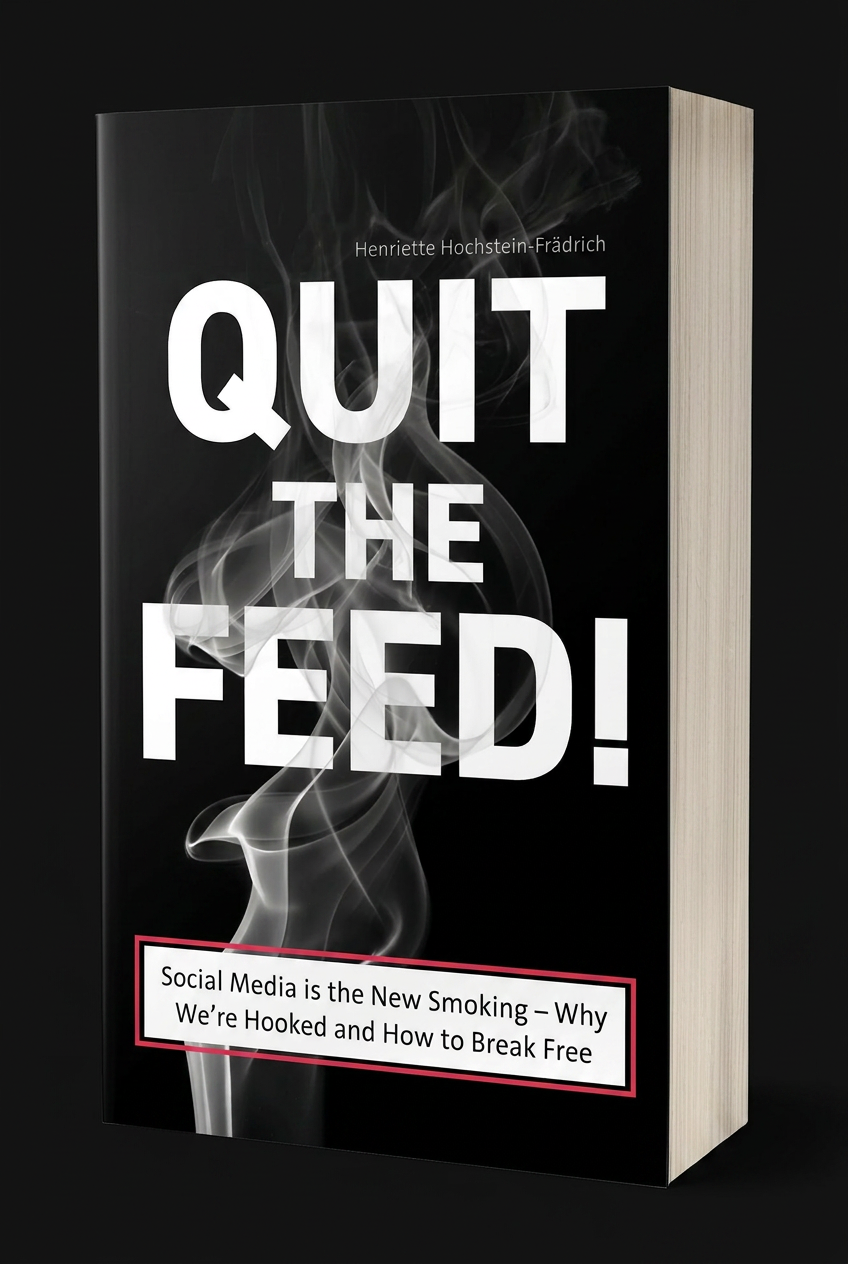
Quit the Feed! — Out of the Dopamine Casino
We don't need to learn "less dopamine." We need to disconnect from overstimulation. The book walks you out of the slot machine in your pocket — structured, clear, without yet another exhausting battle against yourself.
Read the book →What a Good "Dopamine Detox" Actually Does
A sensibly understood dopamine detox is not a dopamine cleanse — it is a stimulus break, better yet, a behavioural break. You interrupt automatic loops. You stop reaching for the fastest available kick every time you feel the slightest inner discomfort. Not every need is immediately numbed, not every boredom immediately filled, not every insecurity immediately scrolled away, not every emptiness wallpapered over with content. You relearn that an impulse is not automatically an instruction. That is huge — because between stimulus and response there is freedom, and social media brutally shortens that space: ping — reach; boredom — scroll; insecurity — post; stress — feed; emptiness — reel; waiting — phone. A good dopamine detox turns that reflex back into a decision. That is not wellness fluff. That is self-leadership. Where the line runs between a cute little break and a real cut is in Digital Detox vs Detoxing from Social Media; if you want the structured version of the cut itself, the protocol is in The Great Withdrawal: 5 Hours, 5 Steps.
People do, of course, also overdo it — and with dopamine detox they often do. Suddenly they quit not just social media but music, exercise, social contact, good food, reading, conversations, joy, life itself, as if any form of pleasure were suspicious. That is not healing. That is control theatre, self-optimisation madness, usually performed (hilariously) on social media. We do not need to stop feeling joy. We may, however, finally allow ourselves to stop being controlled by artificial fast stimuli. The point is not no pleasure. The point is better pleasure. Not less life. Real life again. Not demonising dopamine — but reconnecting it to things that actually nourish us: movement, deep work, nature, closeness, creativity, sleep, learning, real laughter, real conversations, real pauses. Things that don't merely kick. Things that carry.
What Social Media Actually Does to Your Dopamine
Social media is so powerful because it combines several dopamine triggers at once:
- Novelty. The brain loves novelty. Social media delivers infinite novelty. Every swipe: a new image, person, thought, drama, stimulus.
- Social validation. We want to know — am I okay, do I belong, does anyone see me? Likes and comments simulate social resonance, even if they are often just digital crumbs.
- Variable reward. You never know what is coming. That is exactly why you come back.
- Comparison. It hurts, but it hooks. The brain wants status information.
- Emotional alarm. Anger, fear, outrage and scandal hold attention. The algorithm knows: what upsets you keeps you awake.
- Endlessness. No final page. No credits. No "you are done." Your willpower has to set the boundary — and willpower against billion-dollar budgets, behavioural design and AI optimisation is a tired little flashlight in a storm.
This is why you often feel worse after social media than before. You enter with a vague feeling — tired, empty, bored, stressed — and then you get stimuli. A lot of stimuli. Funny, beautiful, horrible, sexy, outrage, comparison, buy-me, you-are-not-enough, the-world-is-ending. Afterwards your brain isn't relaxed. It is stirred, scrambled, emotionally kneaded. You got dopamine but no regulation, input but no processing, simulated contact but no closeness, distraction but no recovery. That is why scrolling often feels like a mental deep fryer — briefly crispy, heavy in the system afterwards.
Dopamine, Craving and the Tiny Inner Junkie
An important word here is craving — that pull, that wanting, that little inner pressure: just quickly check, just one look, just see if someone reacted. Craving is not enjoyment. Craving is the expectation of relief. Craving is addiction — a desire that no longer feels fully controllable, and social media creates it masterfully. The insidious part: often we don't reach for the phone because it brings us so much joy. We reach for it because not doing it has started to feel uncomfortable. That is a massive difference. At first you scroll because it is fun. Later you scroll because not scrolling feels strange. Welcome to the logic of dependency. It is like cigarettes — many smokers eventually do not smoke because every cigarette is a glorious festival of pleasure, they smoke because otherwise the body complains, restlessness appears, something feels missing. The cigarette no longer creates pleasure; it ends withdrawal. Social media works in exactly the same way. If you want to check whether you have crossed into that territory, the self-check is in How to Deal With Social Media Addiction.
The Big Lie: "I'm Just Relaxing."
No, you are not relaxing. You are numbing. There is a difference. Relaxation brings you back into your body; scrolling pulls you out of it. Relaxation widens you; scrolling narrows you. Relaxation regulates; scrolling stimulates. Of course a funny video can be nice, a good article can inspire, a message can connect — but permanent availability, speed, endless novelty and algorithmic intensification turn a tool into a behavioural machine. And at some point you realise: I am no longer using this. It is using me.
What Would a Healthy Relationship with Dopamine Look Like?
A healthy relationship with dopamine does not mean banning all quick pleasures. It means restoring balance between fast and slow rewards. Fast rewards are easy, immediate, intense, but short-lived — scrolling, shopping, sugar, gaming, pornography, binge-watching, endless news, likes, push notifications. Slow rewards require more effort but work more deeply:
- Reading a book, writing something, building something
- Learning an instrument, developing a skill, practising
- Exercising, walking, cooking, sleeping
- Having a difficult conversation, nurturing a friendship
- Sticking with something — living an actual life
The modern problem is not that we know fast rewards. The problem is that fast rewards are everywhere — and slow rewards start to feel like hard work. Social media trains us for now. Real life often works in later. And we need to relearn how to tolerate that "later."
The Real Detox Is: Withdrawal from Immediacy
So maybe we shouldn't talk about dopamine detox at all. We should talk about immediacy detox. Stimulus detox. Impulse withdrawal. Attention reclamation. Because that is what it really is. Dopamine is not the problem. The problem is that our dopamine system is permanently triggered by platforms, apps and business models. We don't need to detox from life — we need to detach from overstimulation. Fewer artificial peaks, more real depth. Fewer mini-kicks, more stable joy. Less stimulus, more resonance. Less feed, more world.
In practice that does not mean throwing your phone into the river (although on certain days that feels emotionally reasonable). It means observing your triggers — when do you actually reach for the phone? boredom, stress, loneliness, overwhelm, procrastination, insecurity? It means taking breaks that are actually breaks, not "a quick scroll on Instagram to relax." It means turning off push notifications (every ping is a tiny foreign intervention into your nervous system; you are not a receiving device for other people's needs). It means building slow rewards back in — reading, exercise, writing, cooking, nature, making music instead of only consuming it, meeting people instead of watching people. It means letting boredom return; boredom is not a defect, boredom is the waiting room of creativity. It just unfortunately looks, at first, like an empty hallway with bad lighting. And above all: don't confuse stimulus with life. If you want to turn observation into consequence, the structured exit programme is in The Great Withdrawal: 5 Hours, 5 Steps; if you're earlier on the staircase, start with Social Media Break: How to Take One (or Quit for Good).
The Good News: Your Brain Can Relearn
Here is the good news: your brain is flexible. That's called neuroplasticity. What it has learned, it can also unlearn. Not instantly. But it can. When you stop answering every inner movement with a fast digital stimulus, something happens. At first it may feel a little restless — your brain nervously asks where is the kick, where is the novelty, where is the little red dot, where is my slot machine? And you say: not today, darling. Then space appears. First strange space, then quiet space, then real space. And at some point you notice: you can think a thought all the way through again. You can drink your morning coffee without immediately flooding yourself with other people's lives. You can stand in a queue without reflexively reaching for your phone. You can feel what you actually feel again. You can distinguish: am I tired or just understimulated? Am I lonely or just unfed by the feed? Am I really bored, or is an original thought just beginning? That is the moment when you do not have less dopamine. You have more freedom.
Dopamine Is Not Your Enemy. But Your Social Media Feed Is Definitely Not Your Friend.
Dopamine is wonderful. It is part of our aliveness, our wanting, our searching, our learning. But precisely because of that, it becomes dangerous when systems are built to exploit this wanting. Social media did not invent our reward system. It simply commercialised it perfectly — taking something profoundly human (our need for connection, novelty, meaning, recognition) and turning it into usage time. That is the real audacity. Not that we have dopamine. But that others profit from triggering it constantly. So dopamine detox is the wrong term. But the right question behind it is this: who is steering my desire — me, or my feed? And if that question makes you flinch for a second, you are already in the right place. Because that is where freedom begins. Not in giving up dopamine. But in ending remote control. Not in a grey, joyless life without stimuli, but in a life deep enough to reward you again. Without a red dot. Without a like. Without a feed. Just you. And real life — finally loud enough again to hear, see, feel and live.
You'll find the full path from understanding dopamine to a structured exit — including the five-hour exit protocol and the first six months without the feed — in the book Quit the Feed!.
Why this constant dopamine trigger works so well, and why it makes the feed permanently hungry, is the subject of Why Your Feed Is Never Allowed to Be Empty.
By Henriette Hochstein-Frädrich, author of Quit the Feed!.
By Henriette Hochstein-Frädrich · Author of Quit the Feed!