How to Deal With Social Media Addiction: The Honest Field Guide
Screen-time limits don't work. Detox weekends don't work. The honest answer is a four-step sequence — see the stories, run a 72-hour diagnostic, decide between managing and cutting, and replace the slots the feed was filling. Here is the field guide.

"How to deal with social media addiction" is the question, and the honest answer is that you don't deal with it — you decide what kind of relationship you are willing to have with it. There is a managed version (rare, hard, requires real architecture) and there is a clean exit. Everything else is the addiction managing you while you tell yourself you are managing it. This piece is the field guide for both versions: the diagnostic that tells you which one applies, and the protocol for each.
Most "how to deal with" advice on this topic collapses into screen-time tips, app blockers, and the suggestion to "be more mindful". None of that touches the thing. Behavioural addictions don't respond to mindfulness any more than nicotine addictions respond to a strongly worded note on the fridge. They respond to structural change. So we start with what the addiction actually is, then move to the four real interventions, in order.
First — Is It Actually Addiction?
The word "addiction" is overused, but the clinical markers are specific and easy to test against. If three or more of the following are true for you, the dealing-with question is no longer hypothetical:
- Tolerance. The amount of time it takes to feel "caught up" or satisfied has crept upward over months and years. Two minutes became twenty.
- Loss of control. You open the app intending to check one thing and surface forty minutes later with no clear memory of the time.
- Withdrawal. A few hours away — phone in another room, plane mode, dead battery — produces real restlessness, low-grade anxiety, or a thumb that keeps reaching for a pocket that has nothing in it.
- Continued use despite consequences. Sleep is worse, attention is worse, mood is worse, the relationships you actually care about get half-attention — and the scroll continues anyway.
- Failed attempts. You have tried to cut down, multiple times, and you are back where you started within weeks.
If you recognised yourself in three or more of those, what you are dealing with is not a habit. It is a behavioural addiction, engineered for exactly that outcome. The full diagnosis — why the parallels to nicotine are not metaphorical, and why "moderation" is the most expensive lie the platforms ever sold — is here: Social Media is the New Smoking. Read it before you try to "deal with" anything. The frame has to be right before the intervention can work.
The Four Interventions That Actually Work (In Order)
There is a clear sequence here. Skip a step and the next one collapses. Each one is a different kind of work; doing them out of order is the single most common reason people who genuinely want out keep failing.
1. See the Stories Clearly
Every addiction is held in place by a small library of stories — reasonable-sounding sentences the addicted person uses to justify continuing. "I need it for work." "I'd lose touch with everyone." "It's how I stay informed." "I only use it a little." As long as those stories sound true to you, no protocol on earth will hold. The reflex will always find one of them to lean on.
This is why the first intervention is not behavioural. It is cognitive. You take each story you tell yourself about why you stay, write it down, and check it against what is actually happening in your life. Most of them do not survive the audit. The fourteen most common ones — and how each one collapses when you look at it honestly — are dismantled in "I Need It for My Business" — and 14 Other Lies We Tell Ourselves. Read that essay before the next step. The diagnosis tells you what the addiction is. The deconstruction takes away the excuses.
2. Run the 72-Hour Diagnostic
Before any decision about quitting versus managing, you need data — and the only honest source of that data is your own nervous system, given three days without the supply. Apps deleted, not hidden. Browser shortcuts cleared. Notifications off across every device. Three days is enough for the reflex to show itself clearly.
What you are watching for is not how much you "miss" the platforms (a misleading metric — almost everyone reports missing them at first, regardless of what comes next). You are watching for the shape of the reaching. How often the thumb moves toward a pocket on its own. How loud the silence feels in the small in-between moments. How quickly the time fills back up with things you forgot you missed. The full version of this 72-hour test, plus the longer 14-day window that follows it, is laid out in Social Media Break: How to Take One (or Quit for Good).
By the end of those three days you will know — not intellectually, viscerally — whether you are dealing with a habit or an addiction. That distinction decides what comes next.
The Full Field Guide to Dealing With It
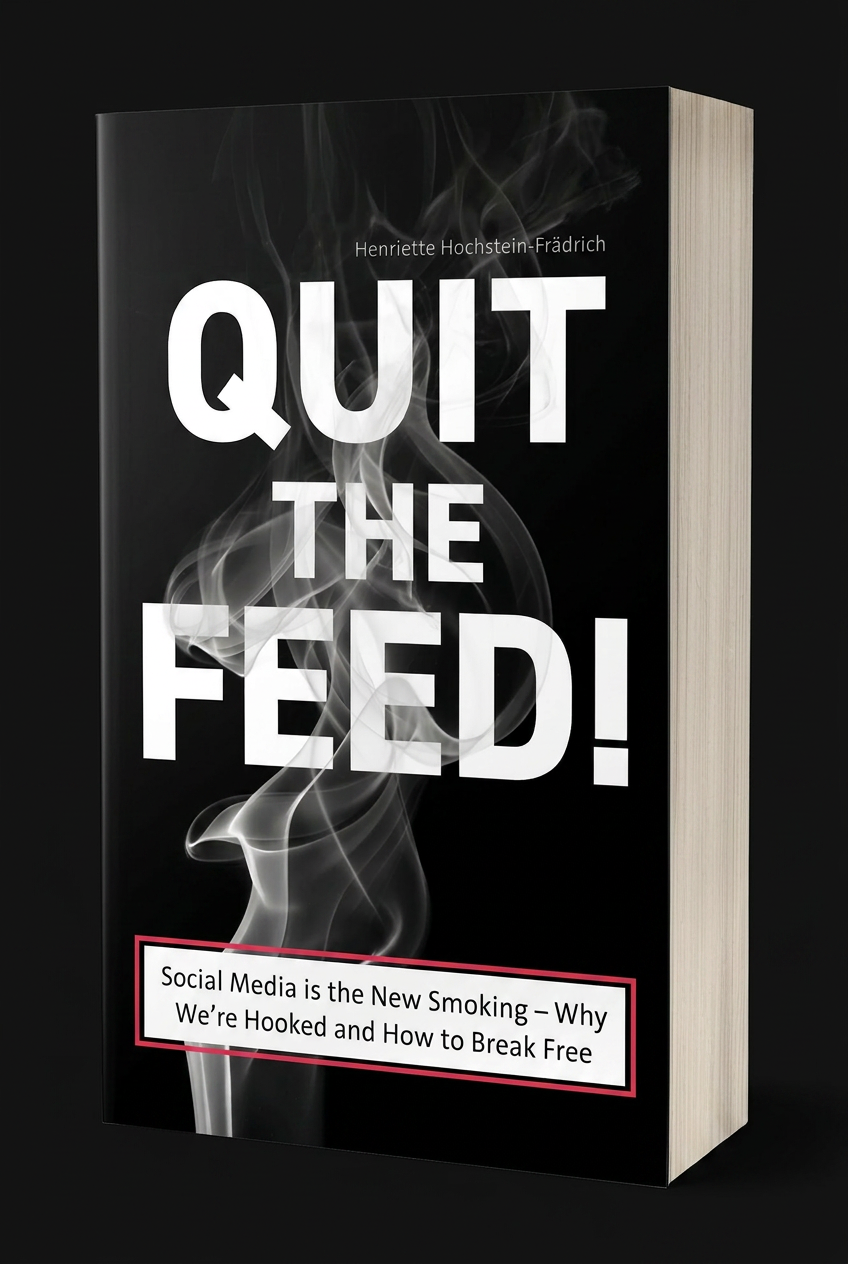
Quit the Feed! is the long version of this essay — every diagnostic, every story dismantled, the five-hour structured exit, the first week, the first month, and the companion through the first six months without a feed. Written for people who have tried "dealing with it" the soft way and quietly know the soft way is not the answer.
Read the book →3. Decide: Manage or Cut
This is the step almost everyone skips, and it is the reason almost everyone is still on the platforms. After the diagnostic, you are obliged to make an actual decision instead of drifting back into the default. Two honest options:
- The managed version. Accounts stay, but the relationship is rebuilt from the ground up. Apps live only on a desktop browser, never on a phone. All notifications, badges and "suggested" content are off. A fixed window per week — for most people one or two hours, on a specific day — and no opening outside that window, no exceptions. The friend or partner who knows is allowed to call you on a relapse. This works for roughly one in twenty people. It requires the kind of architecture most people will not actually build, and the moment any piece slips, the addiction is back inside a week. If you choose this, choose it with eyes open: it is harder than quitting, not easier.
- The clean cut. Accounts deleted, not deactivated. Apps removed. The identity ("I'm a LinkedIn person", "I'm someone who uses Instagram for work") is allowed to dissolve. After the first two weeks, there is genuinely nothing to manage. The reflex has nowhere to fire. Most people who have honestly tried both report this is the easier of the two, by a wide margin — because there is no daily negotiation. The protocol for doing the cut cleanly, in five hours rather than thirty days, is here: The Great Withdrawal: 5 Hours, 5 Steps.
What this step is not: another round of "I'll just try to use it less". You have already tried that. The whole reason you are reading this essay is that it did not work. The honest move is to pick one of the two real options and commit to it long enough to know.
4. Replace, Don't Just Remove
An addiction is never only a behaviour. It is also a job the behaviour was doing for you — usually several jobs at once. The feed was your boredom-killer, your social-anxiety blanket, your end-of-day decompression ritual, your transition between meetings, your fallback when a conversation hit a quiet stretch. Remove the feed without putting anything in those slots and the vacuum will pull it back inside a fortnight. The relapse is structural, not moral.
So the last intervention is replacement. For each slot the feed was filling, name one specific, low-effort thing that goes there instead. A book in the bag for the commute. A walk around the block before opening the laptop. A short phone call to one real human being on the way home. A pen and a small notebook by the bed instead of the phone. These are not glamorous. They do not photograph well. They work because they occupy the exact moments the reflex used to occupy, and after a few weeks the brain stops asking for the old version.
This is also where most "digital detox" approaches quietly fail: they remove without replacing, and the vacuum closes around the old behaviour the moment the detox ends. Dealing with social media addiction means redesigning the slots, not just emptying them.
What Changes — and When
If you actually walk this sequence, the order of what comes back is predictable enough to plan around. None of this is a wellness promise; it is just what the absence of a constant variable-reward stimulus does to a nervous system that was never built for it:
- Day 1–3. Sleep improves almost immediately. Restlessness is real but mostly evening-shaped. The reflex shows itself clearly — that is the diagnostic doing its job.
- Day 4–14. Attention returns in chunks. You can read a page, sit through a film, hear the end of a sentence. Mood stabilises. The algorithmic urgency in your chest gets quieter.
- Week 3–4. The identity ("I'm someone who uses Instagram") quietly dissolves. The friends who matter call. The acquaintances who don't, don't — and you discover that mostly does not hurt.
- Month 2–6. Comparison-anxiety drops to a level you had forgotten was possible. Boredom returns as a useful state, not a problem to solve. The "withdrawal" framing becomes faintly embarrassing in hindsight — the thing you were withdrawing from looks much smaller from the outside of it.
What Doesn't Work — And Why People Keep Trying It
Two more things worth saying out loud, because almost every "how to deal with social media addiction" article gets them wrong:
Screen-time limits and app blockers don't work as a primary strategy. They work as architecture during a quitting protocol — a fence at the cliff edge, not the reason you walked away from the cliff. As a standalone intervention they fail reliably, because they leave the accounts, the cues, the identity and the stories intact. You raise the limit on a bad day, and you are back. The full reason this loop is so reliable is in "I Need It for My Business" — and 14 Other Lies.
Periodic "digital detox" weekends don't work either, for the same reason. A weekend in a cabin with the phone in a basket changes nothing structural. You go home, reinstall, and the loop continues. If you keep needing the detox, the detox is the warning light, not the solution. The honest version of that argument is here: Digital Detox vs Detoxing from Social Media: The Honest Difference.
The Honest Closing
"How to deal with social media addiction" is the polite version of the question. The real version is: am I willing to stop pretending this is manageable? If the answer is yes, the four interventions above are the whole map — see the stories, run the diagnostic, decide, replace. The decision step is the one that matters. Everything else is execution.
The full version of all of this — the diagnostics, the fourteen stories dismantled in detail, the five-hour exit, and the companion through the first six months on the other side — is the book: Quit the Feed!
You are not weak. You are wired, on purpose, by people who profit from the wiring. Dealing with it starts the moment you stop calling it a personal failing.
By Henriette Hochstein-Frädrich · Author of Quit the Feed!