WHAT IF SOCIAL MEDIA WERE ACTUALLY SOCIAL AGAIN?
Follower counts gone, likes private, a feed with an ending, and advertising out of the center: what would a network look like that is actually social again?
We spend a lot of time talking about what social media has become. The obvious response is: get out. But one interesting question remains unanswered — what actually comes next? A counterproposal to follower obsession, reach races, and the endless digital noise machine.
Addictive design. Infinite feeds. Comparison. Hate. Disinformation. Advertising. Data harvesting. Large parts of the internet now feel like someone threw a casino, a shopping channel, a popularity contest and a county fair into a blender. The obvious response: Quit the Feed. And yes — that is exactly what I'm arguing for.
But people still want connection. We want to know what our friends are doing, get updates from our favorite team, artists, organizations, bands and local businesses. We want to exchange ideas, discuss things and occasionally just stay in touch. That basic human need isn't the problem. The system built around it is. So let's turn the question around: What would a digital network look like if it actually delivered what its name promises? Social. Network. Two perfectly decent words that we have somehow managed to bury beneath an impressive mountain of crap.
Following someone? Sure. Follower counts? Who cares.
Let's start with one of the strangest inventions of the modern internet: the publicly visible follower count. You want to know when your favorite football club is playing? Follow them. You enjoy a particular journalist's writing? Follow her. You want to know when the little restaurant around the corner is having its summer party? Follow the account. And then something revolutionary happens: nothing else.
Why does everyone need to see whether another 427 people or 4.7 million people made the same decision? That number turned interest into status. It tells us who supposedly matters, who is big, who deserves attention, who gets brand deals. And it has trained us to measure people before we even listen to them: small number — meh; huge number — wow. As though popularity were proof of quality.
It isn't. An account with 600 followers can be smarter, more interesting and more valuable than one with six million. A piece of writing can genuinely move 50 people and have more impact than a video with 30 million views that everyone forgets before breakfast. So: remove follower counts. You follow someone because you find that person or organization interesting. That's it.
Reach is not a value in itself
Somewhere along the way, we decided that bigger automatically means better: more reach, more visibility, more views, more shares, more growth. One more Reel, one more hack, one more content strategy, one more coach promising to teach you how to "explode your reach" in seven simple steps.
Screw reach. Seriously.
Reach can be useful — if you're warning people about an approaching hurricane or raising awareness around an important issue, you want plenty of it. But as a permanent measurement of human, creative or professional value, it's ridiculous. We have turned quantity into a substitute for quality. What if digital networks were designed around resonance instead?
- A meaningful conversation.
- A thoughtful reply.
- A connection that actually leads somewhere.
- An idea someone remembers.
- An invitation. A real-life meeting.
None of those things needs a six-digit number next to it.
Likes can stay. Just make them private.
Here's another feature we could defuse almost overnight: public like counts. You enjoy a post? Fine. Tap the heart. The person who published it receives the feedback. Everyone else does not need to watch the scoreboard.
Because visible likes change what we create. Topic A performs well — more Topic A. Photo B gets almost no engagement — less Photo B. Outrageous Opinion C explodes — ah, interesting. And slowly, almost imperceptibly, we move away from what we actually wanted to say, write or show and toward whatever performs best. The algorithm becomes the silent editor-in-chief of our lives. Private feedback would remove a large part of that conditioning: you can still receive appreciation — just without the digital stadium scoreboard.
A feed should eventually end
Now here's a truly radical concept: The End. You open your app and see the new posts from the people, organizations and topics you deliberately chose to follow. Chronologically. Clearly. No mysterious machine constantly shoving more content in front of you, no endless "For You" conveyor belt, no random videos from strangers because you happened to stare at a similar clip for three seconds yesterday.
You subscribe to things, you receive those things, and eventually the screen says: You're all caught up. Beautiful. Nothing else to see. Go outside. Call someone. Do some work. Cook dinner. Read a book. Stare at a wall. The internet does not need to be infinite.
The fact that today's platforms rarely have a natural stopping point is not a technological accident — stopping is bad for business. When you stop scrolling, you stop seeing ads. Which is exactly why the current system needs perpetual motion, and why your feed is never allowed to be empty. A healthier network would eventually let you leave.
Comments without the arena
Comment sections were once a lovely idea: people could exchange thoughts, add information, disagree, ask questions. A lot of them now resemble miniature Roman amphitheaters — someone writes something, someone attacks, the next person goes harder, the audience applauds, screenshots are taken, the argument travels.
Because when we argue publicly, we're not only talking to each other — we're performing for spectators. And spectators change behavior: the devastating comeback gets attention, the insult is more entertaining than the nuanced objection, escalation travels further than agreement.
So a different social network could prioritize direct replies. Want to tell someone something? Write to them. Want to disagree? Go ahead. Have a genuine question? Ask — person to person. Public discussion spaces could still exist, of course: politics, science, specialist communities, social issues. But those spaces could be deliberately designed, moderated, slower, with rules. We already understand this principle everywhere else in society — a public square needs rules too, otherwise it turns into a brawl sooner or later.
Hate is not a feature
Which brings us to the part where internet platforms have spent years pretending to be astonishingly helpless: hate speech, threats, racism, dehumanization, targeted harassment. Apparently all of that is terribly difficult to moderate. Meanwhile, the same systems can predict with impressive accuracy which pair of sneakers to show me on Tuesday evening to maximize the chance that I'll buy them. Curious.
Technology could be used differently: AI could detect aggressive escalation early, illegal content could be blocked, threats stopped, users protected, repeat offenders removed. Of course this would require clear rules, transparency, appeals processes and human oversight. And yes — freedom of speech absolutely includes the right to say things other people dislike. Criticism can be harsh, satire can hurt, opinions can annoy the hell out of us. But threatening people, dehumanizing them or systematically terrorizing them is not an essential ingredient of a functioning social space. Offline, we tend to call this boundaries. Online, we've spent years pretending basic standards of behavior are somehow an attack on freedom.
The real issue: get advertising out of the center
Now we reach the core of the whole thing, because all these toxic mechanisms are connected: the platform wants to make money. To make money, it needs advertising. Advertising requires attention. More attention means more time on the platform. More time requires more stimulation: drama, curiosity, comparison, reward, outrage, infinity.
Today's social media is not a terrible accident. It works remarkably well according to the logic of its business model — the full math behind it is unpacked in "15 Lies We Tell Ourselves".
So if we want a different kind of network, we also need a different kind of business model. A social network could simply cost money — three dollars, five, ten. It could be cooperative, non-profit, owned by its members, part of some kind of public digital infrastructure. There are plenty of possible models. The important part: the platform should not need to keep you trapped for as long as possible in order to make your presence financially worthwhile. Because as long as attention is being sold, attention will be manipulated.
Businesses can inform us. They just don't need to stalk us.
Businesses need digital communication too, of course: a café can announce that it's closed tomorrow, a publisher can introduce a new book, a sports club can post results, a band can announce tour dates, a city can warn residents about road closures. Perfect. Anyone interested can follow the account and receive the information. The beautifully old-fashioned logic is: I want to hear from you, so I choose to listen.
What we don't need is the reverse: I never followed you, never asked for you, but some advertising system calculated that I statistically belong to your target audience — so now you appear between my friends' updates seventeen times a week. That is where information turns into manipulation. A genuinely social network would respect relationships. Including digital ones.
And what happens to influencers?
Now this gets interesting. Remove visible follower counts, public likes, reach rankings, most advertising and algorithmic favoritism. What is left of the influencer? In the best possible sense: an interesting person. Someone cooks brilliantly, someone explains physics beautifully, someone makes wonderful music, someone understands politics, someone makes me laugh. Great — I'd like to follow them. That's exactly what networks are for.
What disappears is fame for the sake of fame. No one automatically matters because everyone can see that lots of other people think they matter. It sounds like a small change. It would be an enormous cultural shift. What life without that audience actually feels like is described in "The Happiness Nobody Saw".
Small could become valuable again
The internet trained us to think globally: billions of users, millions of views, hundreds of thousands of followers. But humans have always functioned rather well in smaller groups — the sports club, the neighborhood, the professional community, parents from the same school, people sharing the same strange hobby, a local initiative, a group of scientists, a book club. This is where a social network could return to its original strength: people find one another, exchange knowledge, help each other, make plans, build relationships. And then they go home again.
No global stage required. No content machine. No daily fight for attention. A network is allowed to be small — it is even allowed to be slightly boring. A library is more boring than Las Vegas too, and yet most of us have a pretty good idea which one is likely to be better for our brains in the long run.
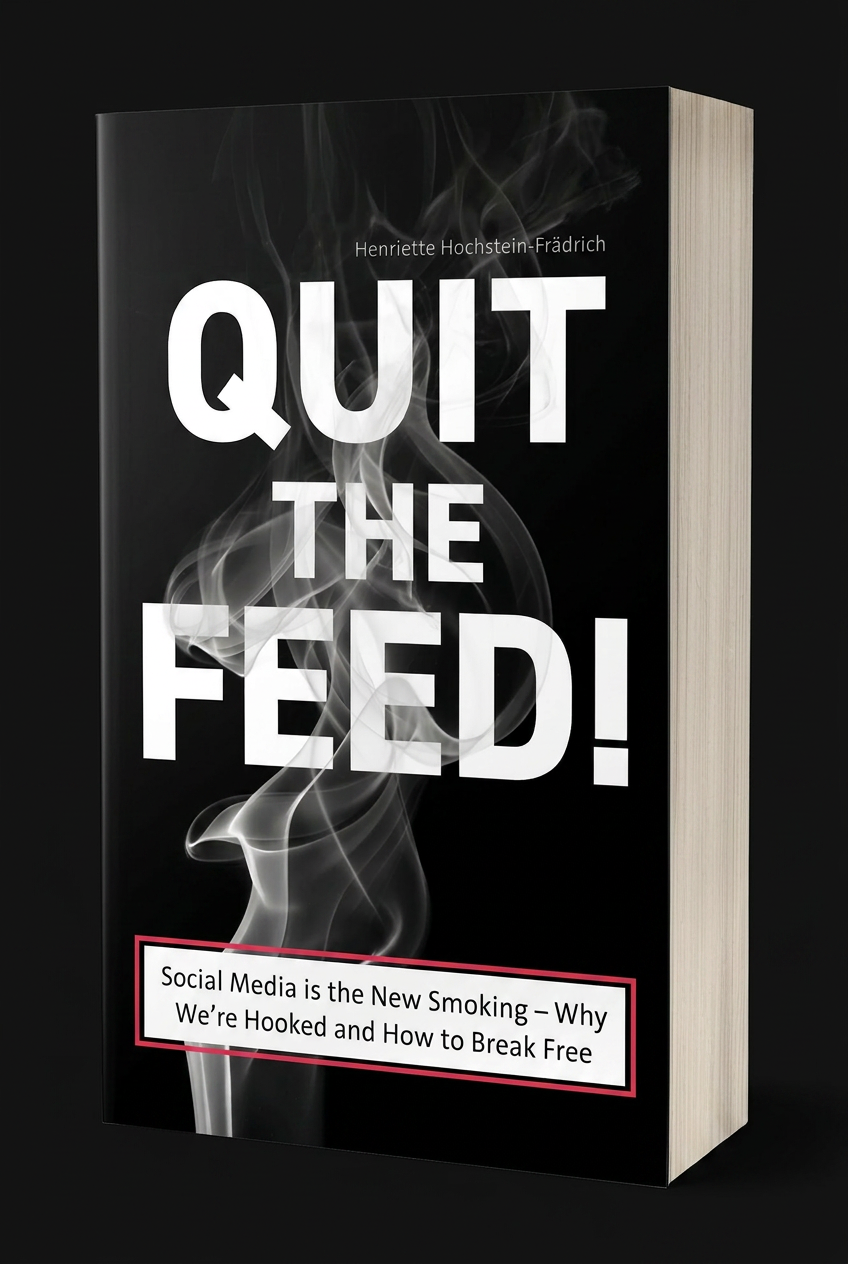
Quit the Feed! — The Real Exit
Leaving the feed is the first step. The book shows how the exit works — and why what waits on the other side is not emptiness, but a life that belongs to you again.
Read the book →We don't need an internet without people. We need one without the casino.
That's really what this comes down to. The desire for digital connection is not the problem, and we do not need to crawl back into some romanticized pre-smartphone world. Digital communication can be useful, beautiful and genuinely connecting. We have simply spent years confusing two completely different things: connection and the attention economy. We need the first. The second is eating us alive.
A future social network could actually look surprisingly unspectacular: you follow people you care about, you receive their updates, you can message them, you find communities, you meet people, you stay informed. And then you close the app.
No popularity scoreboard. No permanent applause machine. No race for reach. No digital fairground. No invisible system desperately trying to squeeze another five minutes out of you.
Less audience. More connection.
Less performance. More exchange.
Less media. More social.
And suddenly, the future of the internet doesn't sound particularly futuristic at all. It sounds remarkably human.
By Henriette Hochstein-Frädrich, author of Quit the Feed!. If you want to start today: The Great Withdrawal: 5 Hours, 5 Steps.
By Henriette Hochstein-Frädrich · Author of Quit the Feed!