Why Social Media Is Bad for You — the Honest, Evidenced Answer
Is social media really that bad? Short answer: yes. The longer one: not everywhere equally, but measurably where it counts — brain, sleep, self-worth, relationships, democracy. A compact overview, with sources, that doesn't moralise — and tells you what to do about it.
Is social media really that bad? The short answer is yes. The longer answer is: not everywhere equally, but measurably where it counts — brain, sleep, self-worth, relationships, democracy. Here is the overview that doesn't moralise. It explains.
1. What social media does to your brain
Every push, every like, every new video is a tiny dopamine hit. Your reward system reacts in patterns documented for nicotine and gambling. The result: your brain learns to anticipate the next reward instead of inhabiting the current moment.
- Variable rewards are harder to walk away from than steady ones.
- Attention spans shrink — not because you got stupider, but because your brain is being trained to switch faster.
- Withdrawal symptoms are real: restlessness, irritation, phantom buzzes in your pocket.
Full mechanics in "What is Dopamine — and Do You Need a Detox?". Why the feed is structurally incapable of being empty is in Why Your Feed Is Never Allowed to Be Empty.
2. What social media does to your mind
Several large meta-studies show links between heavy social media use and depression, anxiety and sleep disorders — especially in teenagers, especially in girls. The 2023 U.S. Surgeon General advisory officially flagged it as a public health issue and called for warning labels on platforms. Just like cigarettes.
That doesn't mean every user becomes ill. It means the risk is not made up. The full tobacco parallel sits in "Social Media is the New Smoking".
3. What it does to your self-worth
Social comparison is human. It was not built for 200 perfectly curated lives per hour. The result: a chronic sense of not-enough — not pretty, not successful, not happy, not visible enough. Even if you know the images are staged, the comparison system fires anyway.
4. What it does to your relationships
You are available everywhere — and present nowhere. Studies show that the mere visible presence of a phone on the table lowers perceived conversation quality. "Phubbing" — snubbing someone for your phone — is now its own research area.
5. What it does to society
- Algorithms reward outrage, not nuance.
- Disinformation travels faster than corrections.
- Public spaces turn into outrage arenas.
- Children and teenagers are dropped into this with no protection — which is why countries like Australia are starting to regulate (see "Australia's Social Media Ban for Children").
"But I only use it moderately"
That's what most people say. It is rarely true. Average daily use lands at 2–4 hours across platforms. If you don't believe it, measure honestly for a week. Or take the addiction self-test.
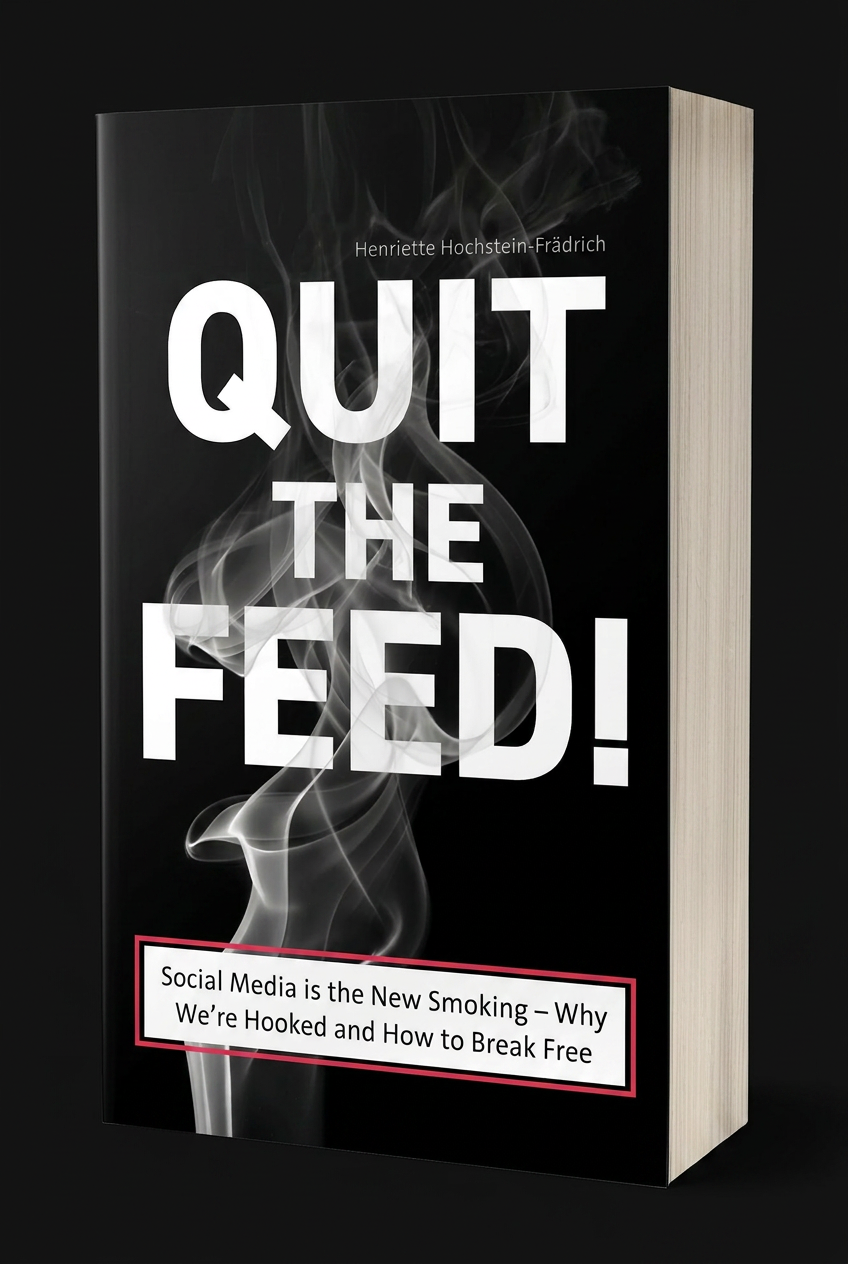
Quit the Feed! — The Full Protocol
Not a manifesto against the internet. A compact, practical guide to walking out — with self-diagnostic, 5-step withdrawal protocol and a relapse plan. So you can leave without disappearing professionally or socially.
Read the book →What to do
- Measure honestly how much time you actually spend.
- Take a real social media break — not "less", but zero, for a defined period.
- If that's not enough: "The Great Withdrawal: 5 Hours, 5 Steps".
- Understand the wider context: "Quitting Social Media is the New Sugar-Free".
- Why the feed itself never stays empty: Why Your Feed Is Never Allowed to Be Empty.
Sources include: U.S. Surgeon General Advisory "Social Media and Youth Mental Health" (2023); Twenge et al., studies on adolescents and screen time; APA, Health Advisory on Social Media Use in Adolescence (2023).
By Henriette Hochstein-Frädrich · Author of Quit the Feed!