So Australia's Social Media Ban "Failed"? No. Australia Is at Least Trying to Protect Children.
Headlines say it failed. They miss the point. Australia is the first country to actually draw a line — a minimum age of 16 on social media — and yes, the first attempt is leaky. So what. Three steps forward, two steps back is still one step forward. Why the mockery is cheap, and why the wildest answer might be: leave the feed completely.

So Australia's social media ban "failed"? No. Australia is at least trying to protect children. While most of Europe is still drafting position papers and scheduling slightly larger roundtables with better catering, Australia did something many people have been demanding for years: a real age limit. It looks imperfect. It looks leaky. And it is still a more honest beginning than any "We are monitoring the situation very closely" press conference.
What Australia did — and how we like to mock it
Since December 2025 Australia has enforced a social media minimum age for under-16s. Platforms have to take "reasonable steps" to keep Australian children under 16 off their services. Not a laminated school flyer about screen time. Not a polite note in the parent newsletter. An actual law — a political attempt to stop asking Big Tech nicely to please be a tiny bit less toxic for kids.
And now the headlines arrive: it is not really working. Or more precisely: not yet. Early research published in The BMJ found little evidence that the under-16 restrictions have immediately reduced adolescent social media use; over 85 percent of under-16 participants reportedly kept using restricted platforms by bypassing inadequate age checks. Cue the predictable reactions:
- Ha. Obvious.
- Bans don't work.
- Teenagers are smarter than governments.
- Boomer politics. Symbolic nonsense.
- Australia embarrassed itself.
Sure. You can see it that way. Or — wild idea — you can lift your head out of the warm little aquarium of European superiority and notice: Australia is at least doing something. Despite all justified criticism of detail, privacy, enforcement and feasibility, that is more than most other countries are doing right now. Which is mostly: debating, waiting, reading studies, creating panels, hosting roundtables — and then probably scheduling a slightly larger one.
Change is not a magic trick
We like to imagine social change as if it were an app update. Download. Install. Restart. Problem solved. Unfortunately, no. Change is rarely elegant. Most of the time it is more like assembling flat-pack furniture with unclear instructions. Someone starts swearing. One screw is left over. Someone lightly bleeds from the thumb. And in the end the shelf may not be perfectly straight — but something is standing where before there was nothing.
Smoking did not disappear because one morning everyone looked at their cigarette and said, "Oh, tar in the lungs — that sounds unpleasant. Let's stop." It took decades. Studies, campaigns, warning labels, advertising bans, smoking bans, taxation, social pressure, new norms. Nobody smokes on planes anymore. Nobody blows smoke into a toddler's face in a car. Nobody places an ashtray on a conference table next to the mineral water. That was not always true — it became true. The full parallel to the tobacco story is in "Social Media is the New Smoking".
So why do we expect one single law on social media to fix everything overnight?
Of course teenagers circumvent rules — so what?
Teenagers find their way around bans. This is about as surprising as the news that water is wet and puberty is not an administrative procedure. They test boundaries. They find loopholes. They want to belong. They do not want to be the only person in class who is not on TikTok, Snapchat or Instagram while everyone else meets there, flirts there, laughs there, compares there, bullies there, performs there and quietly falls apart there.
If you conclude from this that rules are pointless, you might as well abolish school attendance, alcohol limits, youth protection laws, driving licences and shop closing hours. Someone always finds a way around something. That is not the point. Laws are not just technical barriers. They are social signals. They say: this is not harmless. This is not just "what kids do now." This is not something we leave entirely to children, parents and overwhelmed teachers while billion-dollar platforms whisper "community" in the background and sell advertising inventory.
A law does not immediately transform every behaviour. But it changes the framework in which behaviour is judged. It slowly turns "well, they're all on their phones anyway" into: Wait a second. Do they have to be? Should we just let this run? Who is actually responsible here?
Mockery is cheap. Responsibility is expensive.
It is very easy to point at Australia. Look, they can't make it work. Look, the kids are still online. Look, Big Tech is laughing. Yes, all worth discussing. But while we discuss, children and teenagers continue to spend hours a day in systems that were not designed for their mental health. They were designed for engagement, growth, monetisation and more time on platform. Australia, according to Reuters and AP News, has already signalled tougher enforcement and stronger powers for the eSafety Commissioner, with fines of up to A$49.5 million for platforms that fail to take reasonable steps.
That is not failure. That is learning. Failure would look different:
- Doing nothing.
- Looking away.
- Handing children responsibility for a system even adults can barely regulate.
- Letting Big Tech keep pretending the real problem is "user responsibility" or "media literacy."
Ah yes. Media literacy. That lovely phrase that always appears when corporations would rather not be held accountable.
"Then parents just need to pay more attention"
Another sentence that makes you want to rip wallpaper off a wall. Of course parents have responsibility. Of course children need guidance, conversations, rules and role models. But please, let's not pretend parents are up against a neutral toy. They are fighting billion-dollar companies, addictive design, peer pressure, algorithmically optimised stimulation systems, social exclusion mechanisms — and the simple fact that half of their children's peer life now takes place inside these apps.
It is like telling parents, "Just make sure your child doesn't smoke," while placing a cigarette machine next to the school gate that hands out personalised free samples and greets every child by name. That is why political rules matter. Not as a replacement for parenting. But as a protective framework so parenting has a chance again.
A whole generation in a live social experiment
We sent an entire generation into a live social experiment — and never officially decided we were doing it. Here, take this device. Here, take these apps. Here, compare yourself around the clock. Here, let your self-worth depend on likes, views and streaks. Here, look at filtered bodies, war footage, beauty content, violence, pornography, hate, misinformation and perfect lives in one endless stream. Here, learn that boredom is unbearable. Here, learn that you only exist if you are visible.
And now, when one country says, "Maybe this was not exactly a brilliant idea," we respond with: yes, but enforcement is technically difficult. No kidding. Of course it is. But difficult enforcement is not an argument against protection — it is an argument for better protection. We do not say, "Some kids buy alcohol with fake IDs, so let's abolish youth protection." We say: controls need to improve, sellers must be held responsible, adults need to do their job. Why are we so reluctant to apply that same logic to social media?
The first stone in the water is not the end. It is the beginning.
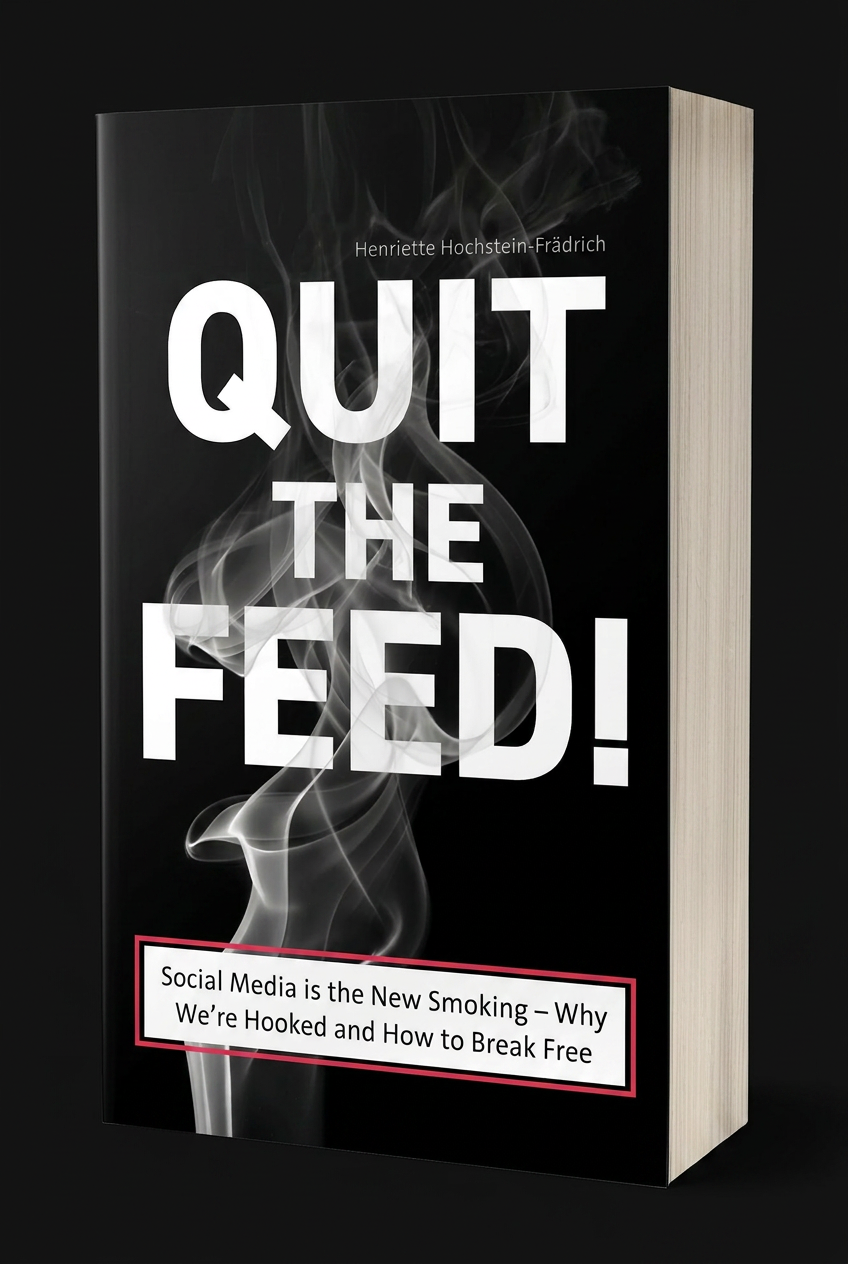
Why leaving the feed is not a matter of discipline but a cultural movement — and why we adults cannot afford to wait until there are laws for us, too.
Read the book →The real success is breaking the taboo
Maybe Australia's first attempt will not be the breakthrough. Maybe the law will be revised, challenged, improved, softened, tightened, redesigned. Good. That is how progress works. The first airbag was not perfect. The first smoking bans were controversial. The first privacy laws did not immediately turn every data-harvesting giant into a polite garden snail. But they shifted something. And that is what is happening here: the previously unspeakable is becoming politically speakable.
- Maybe children should not be on platforms that make adults addicted.
- Maybe "just use it less" is not enough.
- Maybe "parents need to teach media literacy" is a painfully weak answer to a global attention business.
- Maybe platforms should finally have to prove they can protect children — instead of merely claiming safety is very important to them, right after quarterly growth and ad revenue.
Australia has thrown the first big stone into the water. Now everyone is standing on the shore complaining about the waves.
Three steps forward, two steps back is still one step forward
That is the sentence we should probably tattoo on the inside of our eyelids. Three steps forward, two steps back is not stagnation. It is movement. Australia is going through exactly that process: draw a line, watch closely, notice what doesn't work, correct, learn, sharpen, hold the tension, stay with the problem. Exhausting. Unsexy. And much less satisfying than a smug comment under an article. But it is the only way.
We should not laugh at Australia — we should be a little ashamed. Not because Australia is doing everything right, but because it is at least willing to face its own imperfection publicly. That is braver than our polished "We are monitoring the situation very closely." Mockery is childish. Responsibility is adult.
The wildest solution: just leave
And now the thought that feels almost indecently simple in this whole debate. What if the best protection from social media is not making it a little safer, a little more age-appropriate, a little less toxic? What if the most radical, clearest, most liberating step is simply: leave? Not only for children. For us adults, too.
The modern brain immediately screams: but that's impossible! What about visibility? Contacts? News? Inspiration? Business? Trends? Relevance? Exactly. That is the point. Because maybe social media is no longer just a place we "also happen to be." Maybe it is a system we stay in even though it doesn't feel good anymore — like smokers who didn't keep smoking because cigarettes were logical or useful, but because their heads were full of reasons why quitting was not possible right now.
- One last cigarette. One last scroll.
- Just for this one phase.
- Only for work.
- Only for inspiration.
- Only until I am big enough to do without it.
Spoiler: the system is not waiting for you to become strong enough. It profits from you staying. If you honestly want to know where you stand, start with a structured social media break. If you want to take the step out, the protocol is in "The Great Withdrawal: 5 Hours, 5 Steps". And if you want to see the larger picture — why this particular exit is becoming culturally acceptable right now — read "Quitting Social Media is the New Sugar-Free". If you want to understand why the feed itself never stays empty — no matter how much you unfollow — read Why Your Feed Is Never Allowed to Be Empty.
Yes, we have to regulate it for kids. And for ourselves.
We urgently need to regulate social media for children. But we adults can also finally stop pretending we are standing outside the problem. We are not the sober observers of a youth crisis. We are part of the same dependency — just with better excuses and more expensive phones. Even more strangely, simply not being on social media has already become enough to look suspicious — a small everyday absurdity I unpack in "The New Digital Proof of Existence".
The wildest thing might not be Australia's ban. The wildest thing would be allowing yourself the question: What if I simply leave completely? Not as deprivation. Not as defeat. Not as digital hermit life with a wool cardigan and candlelight. But as liberation. As a clear no to a system that feeds on my attention. As a yes to focus, calm, real conversations, real boredom, real creativity.
Australia is trying to get children out of the feed. Maybe the next adult step is not just talking about it. Maybe the next adult step is leaving. Those who start walking can stumble. Those who stay standing can only comment. And honestly, we have had more than enough of that.
Sources: The BMJ (study on early effects), BMJ Group summary, Reuters on enforcement, AP News, The Guardian, Australian Government, eSafety Commissioner, University of Newcastle.
By Henriette Hochstein-Frädrich · Author of Quit the Feed!