Quitting Social Media is the New Sugar-Free
Sugar-free was laughed at first, then it became a lifestyle. Sober followed the same arc. Now the next pleasure is up for the same conversation: social media. Why quitting will become the next big cultural trend — and why offline is quietly turning into the new luxury.
Sugar-free was laughed at first, then discussed, then it became a lifestyle. Alcohol followed the same arc. Now the next pleasure is up for the same conversation: social media. Why quitting will become one of the next major cultural trends — and why offline is quietly turning into the new luxury.
There was a time when sugar was just sugar. It was in cake, cereal, cola, yogurt, tomato sauce and those supposedly healthy granola bars with a woman in leggings joyfully skipping through a wheat field on the packaging. Sugar was childhood, comfort, reward, emotional first aid. Sugar was what your grandmother stirred into pudding and what you gave yourself after a bad day. Sugar was normal.
Then something interesting happened. First, a few people started reading ingredient lists. Then they realized sugar was not just where you expected it to be — it was everywhere. In foods that didn't even taste sweet. In products dressed up as healthy. Yogurts, sauces, dressings, bread, snacks, fitness bars. Suddenly, sugar was no longer just a sweet little pleasure in the afternoon. It was a system. An industrially packaged promise that made people tired, hungry and dependent. Sugar-free was laughed at first. Then discussed. Then tried. Then it became a lifestyle.
Something similar happened with alcohol. A few years ago, if you said at a party "I'm not drinking tonight", you were immediately expected to disclose your medical, reproductive or moral status. Are you pregnant? Are you driving? Are you on antibiotics? Do you have a problem? Or are you just a boring person with sparkling water? Today we have sober curious, Dry January, alcohol-free bars, decent no-gin alternatives and people who stay sober on a Saturday night without apologizing for it. Not drinking no longer automatically looks like deprivation. It looks like clarity. Self-leadership. Like: "I would quite like to wake up tomorrow without having to retrieve my dignity from the recycling bin of last night's decisions."
And this is exactly where we are now with social media. For now, it still sounds strange when someone says "I'm no longer on Instagram." Or "I deleted LinkedIn." Or "TikTok? No, thank you. My nervous system has already been through enough." For now, many still react with that slightly panicked facial expression, as if you had just announced that from now on you'll live without electricity, running water or social existence. How will you know what's going on? How will you stay visible? How will you run your business? How will you network? How will you even exist?
Interesting question. Maybe properly, for the first time in years. Because I believe quitting social media will become one of the next major cultural trends. Not as a quirky niche for digital ascetics, linen-bag minimalists or people who hold a funeral for their smartphone in a sound bowl. But as a real, broad, cultural movement. Like sugar-free. Like sober. Like everything that begins when people quietly think: something about this is not good for me.
Normal first. Suspicious later. Embarrassing eventually.
It's easy to forget how long unhealthy things can remain completely socially accepted. Smoking used to be elegant. Cool. Grown-up. Rebellious. People smoked on planes, in restaurants, in offices, on talk shows. Probably even in pulmonologists' waiting rooms while a doctor somewhere, cigarette in hand, said: "Now take a deep breath." Today, that seems absurd. But back then, it was normal.
And that's the point: normality is not a health certificate. Normality simply means enough people have participated for long enough that nobody asks whether the whole thing is actually a good idea. Social media is still in that phase. It is everywhere. It is taken for granted. It is private, professional, political, social, cultural. It lies next to us in bed in the morning, follows us to the bathroom, sits at the dinner table, comes on holiday, watches our children grow up and clings to every in-between moment of our lives like a small glowing parasite.
We have become used to the fact that no moment stays empty anymore. Not the queue at the supermarket. Not a train ride. Not waiting for coffee. Not an evening on the sofa. Not a sad moment, not a happy moment, not a boring moment. Everything is immediately filled, bridged, stimulated, soothed, entertained.
And in the beginning, it even felt good. Facebook was once genuinely practical. Instagram was once beautiful. Twitter was once funny. LinkedIn was once professionally interesting before it turned into the pedestrian zone of self-staging, where everyone is "humbled and grateful", "sharing a small milestone" and leaving us with "three lessons from this journey". Thank you, Frank. We'll write that down.
Social media promised connection. Inspiration. Visibility. Exchange. Access to the world. And yes, all of that existed too. Small businesses could grow. Movements could form. People found each other who would never have found each other before. The problem is not that social media never had anything good to offer. The problem is that at some point, it tipped.
Connection turned into comparison. Inspiration turned into overstimulation. Exchange turned into permanent opinion. Visibility turned into obligation. "I'll post something" turned into "I really should post something again." And a tool became an environment we spend far too much time living inside.
That's the moment when pleasures become problem products. With sugar, it was the moment we understood: this is not about birthday cake. It's about industrial constant supply. With alcohol, it was the moment people realized: this is not about one glass of champagne. It's about the taken-for-grantedness with which every exhaustion, every celebration, every sadness, every insecurity and every end of the workday has to be poured into a glass. With social media, it will be the moment we understand: this is not about one beautiful photo, one good idea, one helpful contact. It's about a system that does not simply accompany our attention. It harvests it. Why this mechanic is structurally identical to the tobacco industry's playbook is laid out in "Social Media is the New Smoking".
The social media exit begins with exhaustion, not discipline
Major changes rarely begin with a perfect plan. Most of the time, they begin with a vague discomfort. You're tired. Irritable. Restless. Somehow full and empty at the same time. You close Instagram and feel worse than before. You only wanted to quickly check what's new, and now you feel as if your own life is too small, too unproductive, too unattractive, too little Provence, too few abs, too little "I'm so grateful for this incredible journey".
You open LinkedIn and get flattened by people who meditate at 5 a.m., read seventeen books a week, scale three companies on the side and still find time to comment "so important!" under other people's posts. You watch one reel, then another, then another, and suddenly half an hour is gone. Not gone in a good way. Not like after a great conversation or a walk where you think "that did me good". Gone like change falling out of your pocket in a dark alley.
And at some point, you ask yourself: Why am I doing this? That question is dangerous. For every system. Because the moment people stop merely functioning and start feeling again, change begins. With sugar, it was fatigue. With alcohol, the hangover. With social media, it is this strange inner fragmentation. You're busy, but not fulfilled. Informed, but not wiser. Connected, but not held. Visible, but not necessarily seen.
And then comes this thought, softly at first, then louder: I want my life back. Not my profile. Not my reach. Not my personal brand. My life. My mornings. My evenings. My thoughts. My ability to simply sit somewhere without crawling into a device like a nervous hermit crab with Wi-Fi. That is where it begins. Not deprivation. Return.
Digital detox was just the light cigarette
Of course, digital detox already existed. Put the phone away for a weekend. Delete Instagram from your phone. Set screen time to 30 minutes and then negotiate with yourself every day like with a bad-tempered border officer. All of that was well-intentioned. But often that's exactly what it remained: a break. A small wellness excursion out of overwhelm, after which you stepped right back into the same feed. A few days of less stimulation, then the same loop. The same triggers. The same comparisons. The same inner hand movement toward the smartphone the moment a gap appears.
Digital detox is often the light cigarette of the digital world. You feel like you've improved something while the underlying business model remains untouched. A real social media exit goes deeper. It doesn't only ask: how much time do I spend there? It asks: what is this system doing to me? What is it doing to my thinking, my self-worth, my creativity, my relationships, my body, my ability to tolerate boredom? Where the wellness cleanse ends and the actual exit begins is mapped out in "Digital Detox vs Detoxing from Social Media".
And above all: why do I believe I have to be there? That is the crucial point. Many people don't stay on social media because they love it. They stay because they are afraid. Afraid of missing something. Afraid of no longer being visible. Afraid of being left behind professionally. Afraid of becoming irrelevant. Afraid of falling out of the social stream. That is not freedom. That is a rather clear sign of dependence. And once that thought is in the room, it is hard to make it leave again.
Quit the Feed! — The structured exit, not the wellness pause
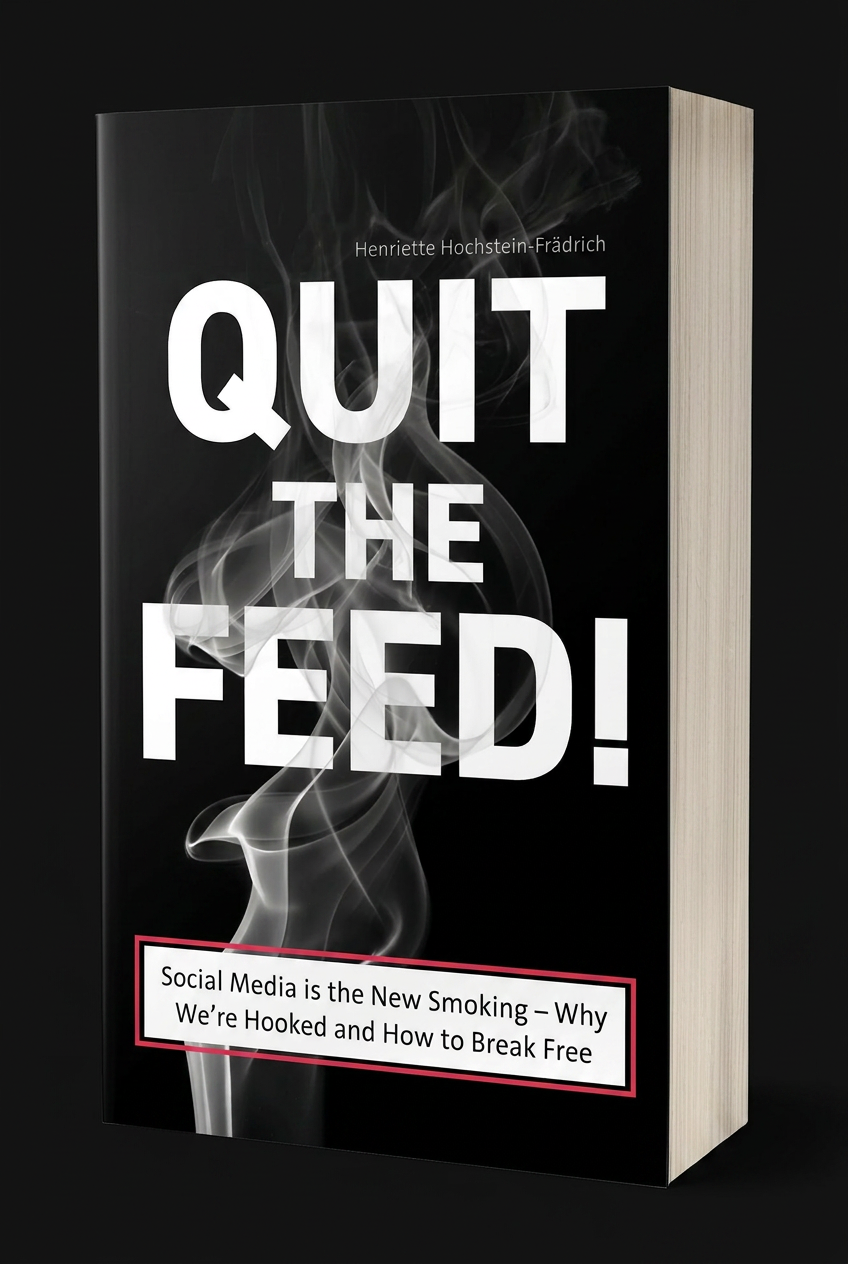
Sugar-free showed us we don't have to satisfy every sweet impulse. Sober showed us that clarity can be more attractive than intoxication. This book turns "quitting social media" into a concrete practice — five-hour exit, relapse plan, and the first six months without the feed.
Read the book →Offline Becomes Status: Life Without Social Media as the New Lifestyle
What's fascinating about social trends is that they rarely run on reason alone. People don't change their behavior simply because studies tell them to. They change when a new way of living becomes more attractive than the old one. Sugar-free didn't grow because everyone suddenly started reading biochemical papers. It also grew because people without sugar loops seemed more awake, fitter, clearer, less constantly hungry. Sober didn't become appealing only because alcohol is unhealthy. It became appealing because sober people looked fresh the next morning while everyone else tried to drag Sunday back into existence with headaches, shame and takeaway pizza.
The same will happen with quitting social media. People who leave will feel different. Calmer. More present. Less frantic in the eyes. Less dependent on reactions. Less tangled up in those permanent micro-comparisons we barely admit to ourselves but that nibble away at our self-worth all day like tiny digital silverfish.
Someone who no longer documents everything suddenly seems sovereign. Someone who no longer comments on everything does not seem uninterested, but collected. Someone who is no longer constantly visible gets something rare back: definition.
Because when everyone is broadcasting, receiving becomes an art. When everyone wants to be visible, deliberate absence becomes magnetic. When every sunset turns into content, the person who simply stands there and looks almost seems subversive. If you want to matter, make yourself rare. Grandmothers knew things. And they didn't even have a content plan.
Offline will not become old-fashioned. Offline will become elegant. Not because technology is bad. I love good technology. I love AI. I love digital possibilities when they serve us. But that is exactly the question: who is serving whom here? A tool is wonderful as long as you can put it down. A tool you can no longer put down is no longer a tool. It is a problem with a beautiful user interface.
The new scarcity is attention
We live in a world where almost everything is available. Information is available. Entertainment is available. Opinions are available. People are available. Images, videos, news, outrage, recipes, workouts, crises, cats, wars, beauty filters, business tips, life advice and fifteen ways to soak oats overnight. Everything is there. Always.
And that is exactly why what used to be natural is becoming scarce: undivided attention. A conversation without a glance at the phone. A thought that is allowed to live longer than thirty seconds. A book that does not have to compete with push notifications. A walk that doesn't immediately become a story. An evening that doesn't have to prove to an audience that it was beautiful.
This will become the new form of luxury. Being unreachable. Not knowing everything. Not knowing every debate. Not living permanently ready to react. Luxury used to mean access. Now luxury will mean withdrawal. Not in a clinical sense, although that subject is serious too. But as a conscious decision not to expose yourself to every stimulus just because it is available.
That is the wider cultural context in which sugar-free and sober also sit. It is about self-protection in a world that constantly offers us more than is good for us. More sugar. More alcohol. More content. More comparison. More stimulation. More choice. More noise. And at some point, something inside us says: I can't do this anymore. That sentence is often mistaken for weakness. Sometimes it is the first healthy impulse in years.
"But I need it for my business" — the last great myth
Of course, here comes the classic. "I'd love to leave, but I need it for my business." Yes. Maybe. But maybe not. Maybe you need clients. Maybe you need a good offer, a strong website, a newsletter, recommendations, search engines, press, collaborations, real contacts, good work, smart positioning and a language that actually reaches people. Maybe what you need is not constant posting, but more substance. More depth. More focus.
Social media has taught us to confuse visibility with impact. But they are not the same. You can be highly visible and still have no relevance. You can post every day and still disappear in the great feed-noise. You can be permanently present on LinkedIn and still lose one thing professionally above all: time, energy and dignity. "I need it for my business" is one of the most stubborn self-deceptions of all — along with fourteen others I dismantle one by one in "I Need It for My Business" — and 14 Other Lies We Tell Ourselves.
Of course, there are people who use social media strategically, within limits and successfully. Wonderful. May the algorithm be kind to them and their nervous system remain intact. But many people do not use it strategically. They are stuck there. They call it marketing, although it feels more like emotional multitasking with a business façade. They call it networking, although hardly any real connection happens. They call it inspiration, although after scrolling they often have fewer ideas of their own than before.
The social media exit will grow partly because it promises enormous professional relief. Imagine self-employed people no longer thinking: I need to post more. Imagine them thinking: I need to work better. Write better. Speak better. Become visible in the right places, not everywhere at once. Even that thought feels like a warm shower for the brain.
The body already knows
What I find fascinating is this: our mind often still defends social media while our body already knows. The mind says: this is normal. The body says: I am tired. The mind says: I need to stay informed. The body says: I am overstimulated. The mind says: this is important for my business. The body says: why does it feel so empty then? The mind says: just a quick look. The body knows: this will take longer again.
We feel the costs. We simply call them different names. Stress. Concentration problems. Comparison pressure. Poor sleep. Inner restlessness. That vague feeling of never being done. Always having to check something. Always having to respond somewhere. Always having to become a little better, prettier, smarter, more visible, more successful.
Social media is not a neutral window to the world. It is a stimulus room. And we spend far too much time living in it as if our nervous system were built for that. It is not. Our brain is not built for 24/7 world events, constant comparison, endless scrolling, beauty simulations, crisis snacks and algorithmically optimized outrage. It is also not built to process holiday photos of strangers, political catastrophes, fitness bodies, business successes and a recipe for high-protein cinnamon rolls before the first coffee of the morning. At some point, that is no longer access to the world. It is contamination by the world.
The new rebellion is quiet
Maybe this is the most beautiful thought: the coming offline trend will not be a loud rebellion. No raised fist against the internet. No hostility toward technology. No romantic retreat into a fantasy world of candles, linen and handmade paper. The new rebellion will be much simpler.
Put the phone away. Do not post. Do not react. Be unreachable. Read a book. Call a friend. Keep a thought instead of immediately turning it into content. Have a beautiful experience without documenting it. Do not know what everyone else is doing. Sleep well anyway. It sounds small. It is enormous.
Because every time we reclaim our attention, we withdraw raw material from a billion-dollar market. Social media does not live on our love. It lives on our habits. Our reflexes. Our insecurity. Our fear of not belonging. That makes quitting more than self-care. It is a small cultural disobedience. A very elegant one, actually. You don't have to shout. You simply stop participating.
The exit will be beautiful
At first, it may feel unfamiliar. When you remove social media, space appears. And space can be irritating. Suddenly there are these little empty places in the day that used to be filled immediately. Waiting. Sitting. Drinking coffee. Riding a train. Walking the dog. Falling asleep. Waking up. At first, there is nothing. And that nothing can make you nervous. Because we have forgotten that nothing does not have to be empty. Sometimes nothing is simply the room in which you can hear yourself again.
After a while, something wonderful happens. The day gets longer. Not in an exhausting way, but in a good way. Thoughts return. Concentration becomes steadier. You read more than three paragraphs again without internally searching for the next stimulus. You listen to people better. You buy less nonsense. You compare yourself less often. You become more creative because your inner space is no longer permanently occupied by other people's images.
And at some point you realize: I didn't miss that much after all. No reel that would have changed my life. No story without which a friendship would have collapsed. No debate that would have died without my comment. No trend more important than my inner peace. Instead, you get something back that is far more valuable: yourself, inside your own life.
That sounds dramatic. But it is practical. In the morning, you are with yourself first, not with everyone else. You experience something beautiful and don't immediately think about the angle. You eat before the food gets cold. You go for a walk and see the sky as sky, not as a content opportunity. That is not regression. That is dignity.
Social media free will become an identity marker
What we choose not to consume eventually says something about how we choose to live. "I don't eat sugar" often means: I protect my energy. "I don't drink" often means: I want to stay clear. "I'm no longer on social media" will mean: I no longer allow my mind to be constantly programmed by other people's noise.
It will become a marker for people who protect their attention. For creatives who want their own voice back. For parents who don't want to lecture their children about screen time while staring glassy-eyed into their own feed. For entrepreneurs who would rather build real impact than perform daily visibility gymnastics. For people who have realized that life does not get better simply because you keep displaying it.
Of course, some will mock it. That's part of the process. Every new awareness has people who say: "Oh, come on, now you're exaggerating." Happened with smoking. Happened with sugar. Happened with alcohol. Will happen with social media. Some will say you simply need to use it in moderation. True. Some can. Some people can keep a bar of chocolate in the cupboard for three weeks and eat one single square every evening. I personally find that suspicious, but fine. Others will realize that moderation is not so easy inside a system optimized for excess. And others will leave. First quietly. Then confidently. Then with a certain lightness.
Out is the new in
Maybe in a few years we'll look back and wonder. Remember when we opened Instagram in bed first thing in the morning? Remember when we photographed our food before eating it? Remember when we thought we had to constantly post about leadership, change and gratitude on LinkedIn to be taken seriously professionally? Remember when every holiday only truly existed once it had been broken down into stories? Wild. Just as we now say: Remember when people were allowed to smoke on planes?
I believe that moment is coming. Not for everyone. Not immediately. But noticeably. The social media exit will grow because it touches a longing more and more people feel: the longing for a life that is not constantly watching itself. For thoughts that are not immediately monetized. For encounters that are not performed. For rest that is not sold back to us as a product. For creativity that comes from within. For days that belong to us.
Quitting social media will not be a fashionable act of deprivation. It will become a liberation trend. Sugar-free showed us that we don't have to satisfy every sweet impulse. Sober showed us that clarity can be more attractive than intoxication. Social media free will show us that absence can sometimes be the strongest form of presence.
And maybe that is the most beautiful punchline of all: we don't go offline because we want less of life. We go offline because we want to feel more of it. And honestly? That could become very big. How far the other side has already gone is captured in this small, very real episode: a press release about quitting social media — refused, because no social media accounts could be shown.
If you want to turn the lifestyle feeling into an actual exit — with the five-hour withdrawal, the relapse plan and the first six months without the feed — the full program is in the book Quit the Feed!.
By Henriette Hochstein-Frädrich · Author of Quit the Feed!