Social Media Break: How to Take One (or Quit for Good)
Three searches, one honest answer: a social media break, taking a break from social media, quitting social media. A practical staircase from a 72-hour pause to a permanent exit — and how to know which one you actually need.

Every January, every burnout, every doom-scrolling Sunday, the same search query lights up: social media break. Sometimes phrased politely — taking a break from social media. Sometimes phrased honestly — quitting social media. They sound like three different questions. They are the same question, asked at three different volumes. This is the answer.
You already know something is wrong. That is why you typed it into the search bar. You don't need another listicle telling you to try a digital detox weekend or "turn off notifications on Sundays". You need the version that actually works — and the honest answer about when a break is enough and when it isn't.
So: a social media break, taking a break from social media, quitting social media. Let's go through all three. In order. With no euphemisms.
What "Taking a Break from Social Media" Actually Means
A break is what you tell yourself when you can't yet face the bigger word. That is fine — every exit starts as a break first. But it helps to be precise about what you are actually buying yourself with the word.
A break, properly defined, is a fixed-length pause during which you remove the apps from the surface of your day so your nervous system can recalibrate. It is not "using social media less". It is not "only at lunch". It is a clean window — seven days, fourteen days, thirty days — in which the feed is genuinely gone. No "just to check". No "for work only". A break with loopholes is not a break, it is a slightly less-bad version of the addiction with a nicer name.
The reason this matters is mechanical. Behavioural addictions are maintained by cue, reflex and reward fired thousands of times a day. As long as the cue (the icon, the notification, the muscle memory of the unlock-and-swipe) stays in place, the loop stays alive. A break only does its work if the cue genuinely goes away for long enough that the reflex weakens. Less than seven days and the reflex barely flinches. Closer to thirty and something interesting starts happening: you forget to reach for it.
The 7-Day Social Media Break (and Why Most Don't Stick)
The classic version — and the one almost everyone tries first — is the seven-day social media break. Sunday to Sunday. Apps deleted from the home screen. Notifications off. A small, smug sense of doing something virtuous.
Here is what usually happens. Days one and two are a strange relief: more time, more focus, the surprising discovery that you were checking Instagram roughly every eleven minutes. Day three is harder than you expected — a flat, slightly irritable feeling, a thumb that keeps drifting toward where the icon used to be. Day four is the pivot point. Day five, if you make it, starts to feel calm. Days six and seven feel almost easy.
And then Sunday evening arrives. The break is "over". You reinstall, "just to check what I missed", and inside forty minutes you are back to the old volume, the old loops, the old you. By Wednesday it is as if the break never happened.
Why? Because a break is a pause inside the addiction, not an exit from it. The accounts are still alive, the password is still saved, the identity ("I'm someone who posts on this") is intact. The seven days proved you can stop. They didn't change anything about why you started in the first place. Which is exactly why, for a lot of people, the seven-day break becomes the first honest moment of the bigger question underneath: do I actually want this back?
If your answer is a confident yes — go back, with a clearer relationship to the thing. If your answer is even a quiet no, you are not really asking how to take a break anymore. You are asking how to quit.
When a Break Becomes Quitting Social Media
There is a specific moment, usually somewhere around day four or five of a real break, when the question changes from "how do I survive the rest of this week?" to "why exactly was I doing that to myself?"
That question is the doorway. Most people walk back through it into the old life because they don't have a protocol for what comes next. They know how to not use Instagram for a week. They don't know how to be a person who has left.
The honest version: quitting social media is not a longer break. It is a structural change. A break is "the apps are off my phone". Quitting is "the accounts are gone, the identity is gone, the reflex no longer has anywhere to go". One is willpower against a still-loaded weapon. The other is unloading the weapon. Only the second one is stable.
The neurology behind why moderation reliably fails — and why a clean cut works — is unpacked in Social Media is the New Smoking. Read it if you still half-believe you can "just be more mindful about it". You can't. Almost no one can. That is not a moral failing — it is how the platforms are engineered.
A Practical Protocol — From Pause to Permanent
So here is the version that actually works, regardless of which of the three questions brought you here. Treat it as a staircase, not a menu.
- The honest 72 hours. Delete the apps from your phone for three days. No "just the work account". No browser workaround. Three days, hard, no exceptions. This is the diagnostic phase: how often did your thumb reach for an icon that wasn't there? How loud is the silence? Almost everyone is shocked by the answer.
- The 14-day social media break. If the 72 hours told you something — and they will — extend to fourteen days. Same rules: apps off, notifications off, no browser shortcuts. Two weeks is long enough for the reflex to soften and short enough that it doesn't feel like a life sentence. By day ten you will know whether you are taking a break or quitting.
- The verdict. On day fourteen, sit down with a piece of paper and write the honest answer to one question: what did I actually miss? Not what you told yourself you would miss. What you actually noticed was gone. For most people the list is embarrassingly short — a handful of names, a few specific contexts. Nothing that needs a feed.
- The cut, or the return. If the list is short, you already know. Don't reinstall. Delete the accounts. The five-hour exit protocol walks you through the cut step by step — including the parts the platforms make deliberately uncomfortable. If the list is long and real, return — but return with rules, an app-time limit you actually enforce, and a recurring monthly break to keep the reflex from rebuilding.
That is the entire framework. Everything else — the "30-day social media detox challenges", the colour-coded screen-time apps, the breath-work hacks — is decoration around the same staircase.
When the Break Isn't Enough
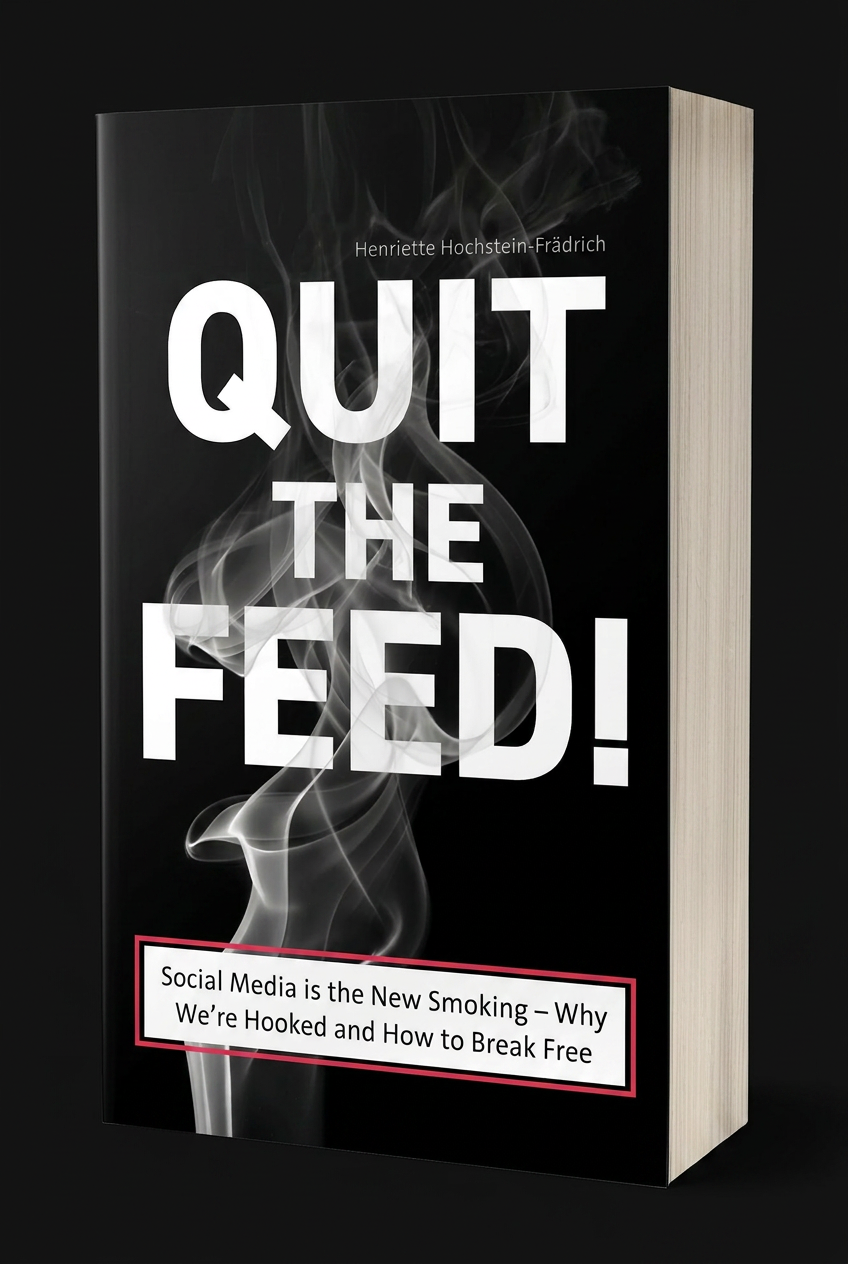
Quit the Feed! is the full version of this protocol — the diagnosis, the deconstruction of the stories that keep you scrolling, the five-hour exit, and the companion through the first six months without a feed. For everyone who tried the seven-day break, knew it wasn't enough, and is finally ready for the real answer.
Read the book →What Changes in the First Week Without the Feed
People ask what they get in return for the break. The honest list, in the order it actually arrives:
- Time, immediately. Two to four hours a day, depending on how bad it was. You will not know what to do with them at first. That is the point.
- Sleep, within three days. The pre-sleep scroll is, for most people, the single worst thing they do to their nervous system. Removing it is the cheapest sleep intervention on earth.
- Attention, within a week. The ability to read more than three paragraphs without checking something. The ability to sit through a meal, a film, a conversation.
- Mood, within two weeks. Less comparison, less low-grade outrage, less ambient envy. You stop measuring your life against a curated highlight reel you never agreed to enter.
- Relationships, within a month. The friends who matter call. The acquaintances who didn't fall away. Both turn out to be okay.
None of this is a wellness promise. It is what the absence of a constant stimulus does to a nervous system that was never built for it. You don't have to believe it in advance — the first 72 hours will show you.
How to Make the Break Last
The break works while you are inside it. The trick is what you build on the way out. Three things keep a social media break from collapsing back into the old volume:
- Replace the cue, not just the behaviour. The reflex isn't really "open Instagram" — it is "fill this small moment of boredom". Decide in advance what fills it instead. A book in every bag. A pen by the bed. A walk after dinner. Without a replacement, the old reflex wins by default.
- Name the leaving out loud. Tell two or three people you trust: I'm off it. Spoken commitment moves the decision out of the private negotiation chamber where addictions live. The version of you who quietly reinstalls at 11pm cannot survive the version of you who said it at dinner.
- Stop trying to be moderate with a thing that is not designed to be used moderately. The platforms are engineered against your moderation. Recognising that is not defeat — it is clarity. You don't drink lightly from a faucet that was built to spray. You turn it off.
And before you reinstall "just to see if anything happened" — read the second essay in this series: "I Need It for My Business" — and 14 Other Lies We Tell Ourselves. The most reliable saboteur of a social media break is not the algorithm. It is your own internal lawyer, arguing why this time is the exception.
The Honest Closing
If you came here looking for a gentle break, take the gentle break — but take it cleanly, for at least fourteen days, and listen to what it tells you. If you came here suspecting you actually want out, you are not alone and you are not overreacting. Quitting social media is, for a growing number of people, the single most consequential change they make in a decade. Not because the platforms are evil — although the business model is — but because the time, attention and quiet on the other side turn out to be the things a life is actually made of.
If the break confirms the bigger answer, the protocol for the real exit is here: The Great Withdrawal — 5 Hours, 5 Steps. The diagnosis underneath the whole thing is here: Social Media is the New Smoking. And the full companion — every script, every prompt, the first hour through the first six months — is the book: Quit the Feed!
Take the break. See what it shows you. Then decide.
By Henriette Hochstein-Frädrich · Author of Quit the Feed!