"Clipping" on Social Media is Making Us Stupid: The Final Boss of Our Attention Span
Clipping sounds harmless — but it is the new hatchet of the attention economy. Conversations become bites, thoughts become hooks, complexity becomes confetti. Why short videos are dismantling our ability to think, and what to do about it.
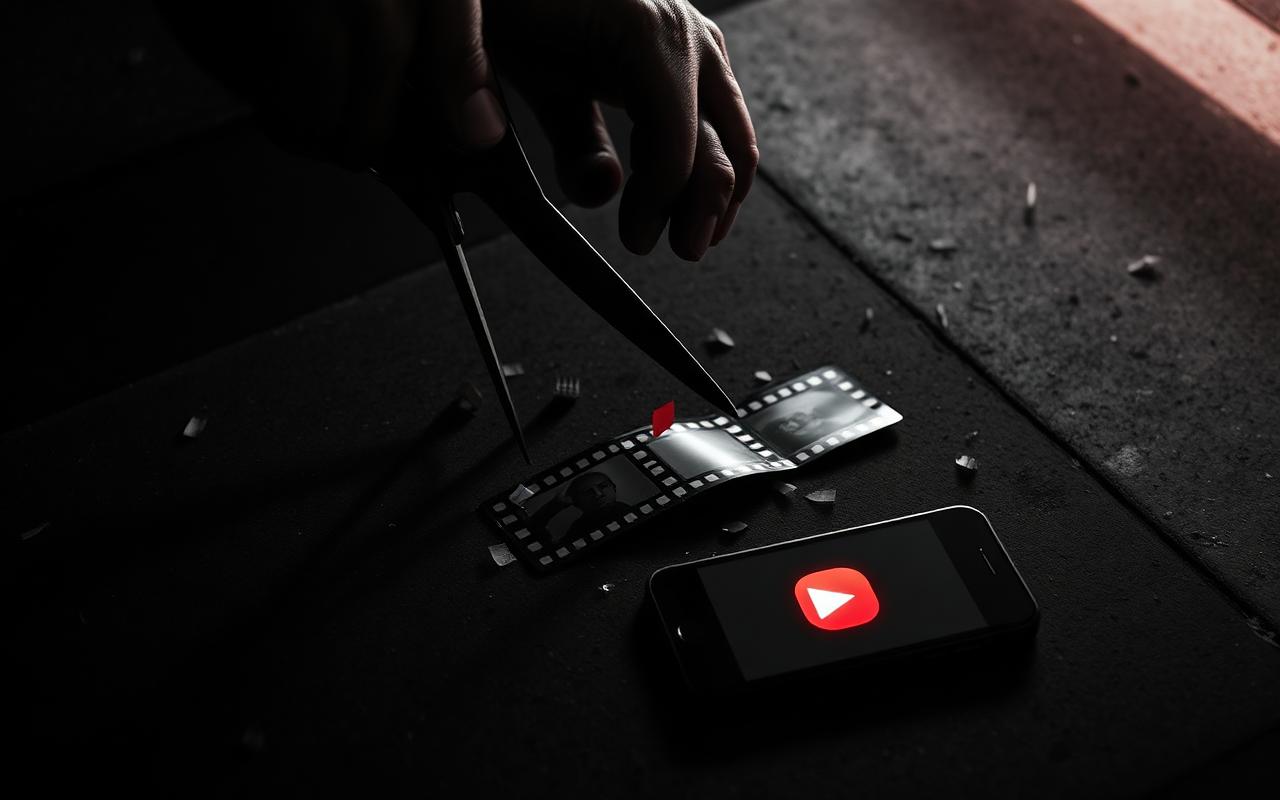
"Clipping" sounds harmless. Like crafting with scissors, like cutting out coupons, like a tiny media innovation. It is not. Clipping is the new hatchet of the attention economy — and the proof that social media is dismantling our ability to think and making us collectively dumber in the process.
There are words that sound harmless at first. Clipping, for example. Almost cute. Like primary school, when you glued a crooked little Mother's Day heart out of colored paper and the teacher still said: "Very nice, Henriette." Clipping sounds like paperclips, clean edges, a small, practical media innovation. But it is not.
Clipping is a format that takes longer content and slices it into short, maximally sharpened video snippets. One sentence, one facial expression, one scandal moment, one artificially dramatic cut, one caption that looks as if someone confused Caps Lock with caffeine — and there it is: the next tiny digital outrage pastry. Crispy on the outside, empty on the inside, sprinkled with a little indignation on top, ready to be snack-consumed.
We now live in a media reality where content is no longer told, explained or contextualized. It is filleted. Conversations become bites. Thoughts become hooks. People become usable moments. Complexity becomes a clip designed to kick your nervous system in the face as quickly and as strongly as possible.
Boom, attention. Boom, dopamine.
And of course we look — because our brain is built to react to stimuli: movement, faces, conflict, surprise, danger, reward. Boom, attention. Boom, dopamine. Boom, next clip. And because the feed never says "All right, darling, that's enough now, go outside and look at a tree," it just keeps going. Another snippet. Another face. Another sentence ripped completely out of context. Another person who looks, for one brief second, as if they have just discovered the truth about the universe — when maybe all they actually said was: "Guys, you are all cooking broccoli wrong."
This is the new media reality: we no longer consume content, we inhale fragments. And then we seriously wonder why an entire generation is growing up with less patience, less depth, less focus — and, in some studies, even declining cognitive performance. If you want to understand why this stimulus-reaction carousel is so sticky, the neurological deep dive is in "What Even Is This Dopamine Everyone Keeps Talking About?".
Clipping is not a trend. It is a symptom.
Clipping is not a funny little content trick for creators trying to squeeze another 48 reels out of one podcast episode like the last sad bit of toothpaste from a tube. It is a symptom. It shows where social media inevitably leads when a system is optimized exclusively to capture attention:
- Everything that takes longer gets cut up.
- Everything nuanced gets sharpened.
- Everything quiet gets made louder.
- Everything that needs context gets pressed into a clip until it clicks — or cracks, inside your head.
Life is not a reel — and does not come with subtitles in capital letters
Our thinking does not actually work in snippets. A thought needs time. An argument needs structure. Knowledge, experience and skill take years, often decades. A feeling needs space. An insight sometimes needs detours, pauses, contradictions, friction. That is why good conversations are often not immediately good — they become good. You feel your way in, you phrase things badly, you correct yourself, you laugh, you fall silent, you suddenly understand something. Life is not a reel. Life does not come with subtitles in capital letters. Life is often inelegant, slow, contradictory, sometimes very, very boring — and precisely because of that, true.
Social media turns all of this into: "Wait until the end!" Spoiler: most of the time, nothing happens at the end. And if it does, it is usually pretty hollow. What does happen is your next reach for the phone and your next little scroll-swipe-whoosh movement. You are stuck in clipping hell, your monkey brain craving the next sensation that is not actually a sensation. And even if it were — what would it improve, change, move or positively affect in your life? Exactly. Nothing.
Visibility is not substance
Clipping is the logical escalation of a culture that confuses attention with meaning. If a clip goes viral, it seems important. If someone is clipped often, they seem relevant. If a face appears in your feed constantly, it creates the illusion of significance. But visibility has never automatically meant substance. You can stand very loudly inside a burning dumpster — that does not make you the torch of enlightenment.
And yet the system rewards exactly those moments. Not the intelligent thought that slowly unfolds. Not the deep conversation that only reaches the painful point after twenty minutes. Not the calm analysis that does not need a punchline. What gets rewarded is the moment that triggers, the sentence that lands, the look that hits, the outrage that is instantly understood, the face that works as a thumbnail.
Is Social Media Making Us Stupid? Yes — Here's How
The problem is not only that we are becoming less well informed. The problem is that we are learning to think differently. Or let's call it what it is: we are getting dumber. Anyone who bathes in clips for hours every day trains their brain for a world without transitions. Everything begins immediately. Everything escalates immediately. Everything has to work immediately. The inner rhythm changes: patience suddenly feels like boredom, nuance like an excuse, reading like work, listening like an imposition. And eventually, you sit in front of a normal text, a real conversation, a book, a human being made of flesh, warmth, breath and imperfection — and you think: Wait. This has no jump cut. How am I supposed to stay with it?
I am fairly sure this also has something to do with why more and more people struggle to maintain normal relationships. Because a normal relationship is not made only of highlights. Exactly that is what makes clipping so perfidious: it does not only train us to consume more content — it trains us to tolerate less reality.
Clipping is the light cigarette of the content world
And here we are again with my favorite little theory, this charming thought with a hint of digital nicotine: social media is like smoking. Years ago, people also thought: "Oh come on, one cigarette in between, what's the harm? It's social. Everyone does it." Today we say: of course it was not harmless, of course it was a business model with addictive potential, of course a lot of money was made with a lot of denial. The full parallel — neurologically, economically, industrially — is in "Social Media is the New Smoking".
With social media, society is currently somewhere around the phase where ashtrays are still standing everywhere and someone in a restaurant says: "Do you mind if I briefly smoke up your prefrontal cortex?"
Clipping is the light cigarette of the content world. Looks smaller. Feels harmless. It is just a short clip, just a few seconds, just a tiny excerpt, just a little entertainment. That trivialization is exactly what makes it so dangerous. Because the individual clip is rarely the problem. The chain is the problem. The loop. The habituation. The reach for the next stimulus. The inability to stop, even though you can already feel that you come out of it emptier, more scattered, more irritable and somehow dumber than when you went in.
Anyone now thinking "Well, then I'll just do a digital detox" may take one deep breath and then read this very carefully: digital detox is often just the new light cigarette. This whole "I'll delete the app for the weekend and then post a selfie with the hashtag offline" thing may be well meant, but it is often wellness for a guilty conscience. A little less scrolling, a little app timer, a little grayscale mode — and suddenly you feel like Gandhi with a screen time report. Meanwhile, the system is laughing its head off.
Because social media does not live from the fact that you take a three-day break once a month. It lives from the fact that you come back afterwards. From the reflex. From the excuse. From the "just quickly." From the feeling that somehow, you still have to be there. And clipping makes coming back even easier — because you no longer even need the feeling that you are committing to something. You do not have to listen to the podcast. You do not have to watch the interview. You do not have to read the article. You get the emotional concentrate straight into the vein. Mini dose, maximum effect. And boom — you are back on it. This is why the feed can never stay empty: read Why Your Feed Is Never Allowed to Be Empty.
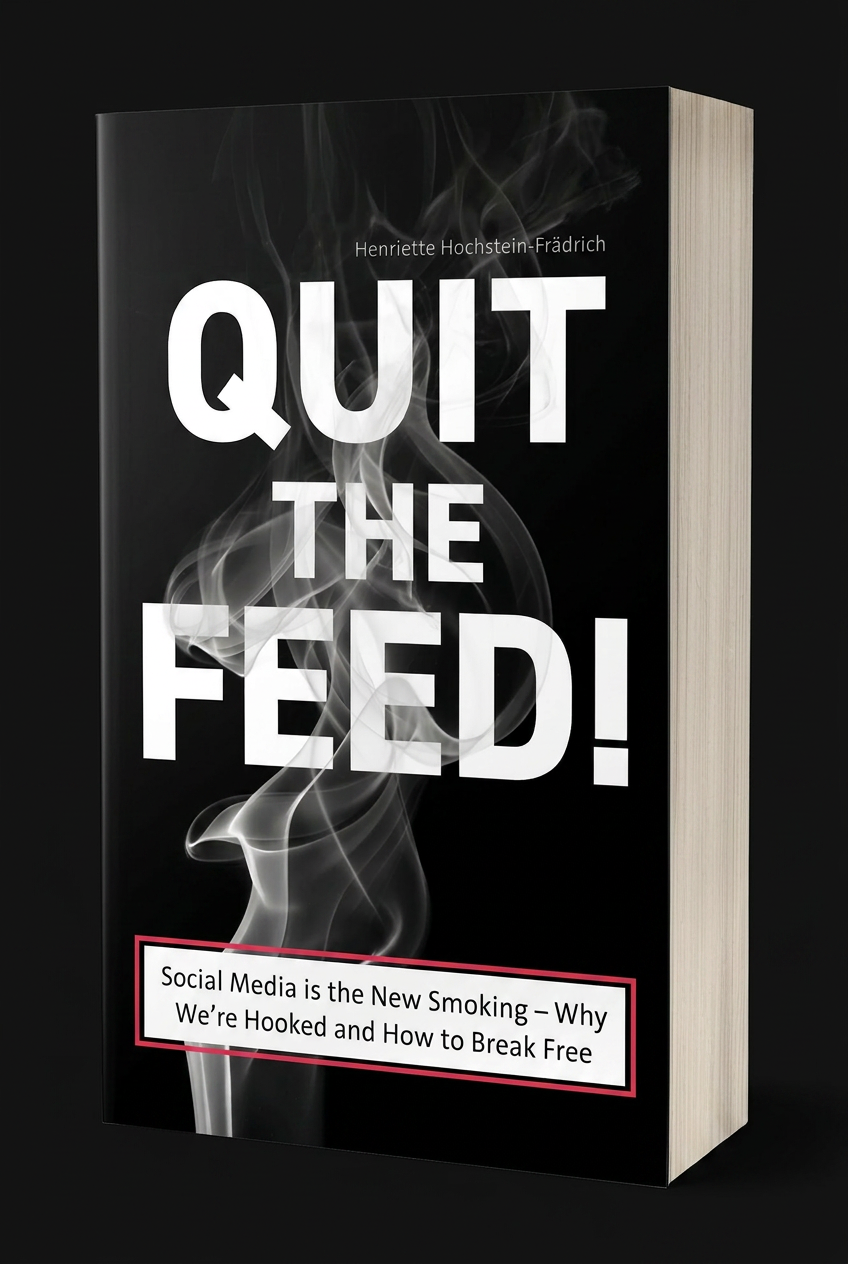
Quit the Feed! — The Mental Exit
No weekend detox, no app timer. The full diagnosis of how platforms, clipping and dopamine keep you hooked — and the structured exit protocol to actually get out.
Read the book →Reality becomes clip-shaped
Then something happens that we urgently need to take more seriously: reality becomes clip-shaped. Politics becomes clip-shaped. Education becomes clip-shaped. Relationships become clip-shaped. Even outrage becomes clip-shaped. Everything must work within seconds, otherwise it is supposedly not relevant. But what is truly relevant is often bulky. A smart thought rarely flirts well with the algorithm. A genuine insight rarely comes with a smash cut. And a person who truly has something to say sometimes needs longer than eleven seconds.
But who still has the nerves for that? That question is bitter, because it hits us — me too, of course. I was not born a digital nun sitting at the window in linen clothes, drinking herbal tea and philosophizing about the purity of analogue existence (although, to be fair, I do find the analogue rather sexy — it has magic, while the digital, for all its brilliance, rarely truly satisfies). I was in there too. I know the pull. I know the "just quickly." I know the feeling of resurfacing after half an hour of scrolling like after a mental bar crawl: slightly ashamed, somehow sticky in the head, with the vague sense that you have once again exchanged real life for someone else's micro-drama.
That is exactly why I write about it. Not from superiority, but from experience, anger and concern — and, yes, also from love for real life, which is quieter than the feed but smells a hell of a lot better.
The feed turns us into reaction zombies
Clipping makes the losers of this new media reality visible. The losers are not only traditional media, long formats or people still capable of building whole sentences. The biggest losers are us:
- our attention,
- our ability to hold complexity,
- our patience with others,
- our tolerance for ambiguity,
- our desire to think for ourselves instead of being spoon-fed other people's thoughts in little bites.
The feed does not turn us into informed people. It turns us into reaction zombies. We see something and immediately feel: anger, envy, desire, fear, superiority, disgust, FOMO. Then comes the next clip. No processing, no context, no inner echo. Just stimulus, reaction, next. This is no longer media consumption. This is nervous-system bowling.
And at some point the question becomes: Am I still free in my attention? Or am I already being played? If that feels uncomfortable, good — that discomfort is information. Do you reach for your phone first thing in the morning? Can you watch one video without opening five more afterwards? Do you genuinely feel better after social media, or just briefly numbed? Do you still experience boredom, or do you fill every tiny gap with someone else's material? These are not small questions. They are freedom questions.
Attention is your life in real time
Attention is not a side issue. What you pay attention to becomes your day. What you feed your mind with becomes your thinking. What you constantly see changes what you consider normal. If you consume fragments all the time, you eventually become fragmented inside: a little bit here, a little bit there, a little outrage, a little comparison, a little body optimization, a little end of the world, a little cute baby animal, a little business guru with a rented Lamborghini. And at the end, you sit there wondering why you are so tired.
Maybe because your brain had to sort confetti all day. The sad punchline: we call this entertainment, but it is work. Your brain is working constantly — sorting, evaluating, comparing, reacting, storing, rejecting, desiring, fearing. And the platform profits from it. Clipping is an efficiency booster in this game: it makes content faster to consume, easier to emotionalize and simpler for the algorithm to test. Every clip is a tiny bait. Some are ignored, some explode, and once one works, the pattern is repeated, copied, optimized, multiplied — until the feed looks like an endless snack bar for overstimulated mammals. This is not culture. This is content fattening.
Yes, but there is good content too …
Of course one can now say: "But there are good clips too — educational videos, science, politics, humor, art." Yes. Of course. There were also good cigarette breaks with nice conversations. That did not make smoking healthy. The problem is not every individual piece of content. The problem is the architecture in which these contents take place — an architecture that does not want to make you wiser, calmer or freer. It wants to keep you. For as long as possible. As often as possible. As deeply as possible.
That is why it is not enough to consume "better content." It sounds nice, but it is often just the next excuse. Then we stop following beauty influencers and start following neuroscientists with ring lights. Instead of toxic comparison feeds, we watch self-optimization clips with study graphics. Instead of cat videos, we get stoicism in twelve seconds. The result: we feel more intellectual while scrolling, but we are still scrolling. The cage simply has a bookshelf in the background.
Are you still clipping, or are you already living?
So what if we simply left? Not dramatically, with a fog machine and a farewell post — sorry, farewell clip, of course, preferably with tears and very, very heavy emo music. No. Just out. Less feed. More world. Fewer snippets. More context. Less reaction. More thinking. If something is tugging at you right now, the practical entry point is here: "The Great Withdrawal: 5 Hours, 5 Steps". Of course this is not about throwing your smartphone into a lake and training carrier pigeons from now on. It is about self-leadership. About clarity. About deciding that your mind is not a public transit station for algorithmically sorted stimulus goods.
And yes, at first it will feel strange. The feed is missing like a noise you got used to for too long. Suddenly there is silence. A queue at the supermarket without your phone feels like a spiritual extreme sport. Coffee without scrolling feels suspiciously analogue for a moment. Your own thought returns and stands a little shyly in the doorway because it has not been invited in for so long.
But then something beautiful happens. You realize that your day becomes longer. Not objectively, unfortunately — an offline day still does not have 37 hours, which is deeply regrettable; I would have suggestions. But it feels bigger. Less chopped up. Less remotely controlled. You read for longer again. You listen better. You go outside and look not at a display, but at the world. You no longer have to immediately process every interesting thought into content and throw it to the social media wolves. You are allowed simply to have it. What a luxury — a thought that belongs to no one but you.
Briefly everywhere — and truly nowhere
That is the real scandal: we still believe social media gives us connection, inspiration, information. In truth, it often takes away the very conditions required for those things. Connection needs presence. Inspiration needs emptiness. Information needs context. And all of that becomes difficult when your brain is supposed to digest a new clip every few seconds.
Clipping is therefore more than a media trend. It is a warning light. It shows how far fragmentation has already progressed — not just on the internet, inside us. Our inner operating system is lagging. We keep changing channels even though the television is no longer on. We are briefly everywhere and truly nowhere. We call it connected, but sometimes it is simply scattered with Wi-Fi.
Do we really want to continue calling this normal? Do we want children to experience thinking as a sequence of bright, loud clips? Do we want public debate to be increasingly shaped by viral fragments? Do we want to keep offering our nervous systems as testing grounds for platform design?
That sounds big. But every social change begins at some point with a very personal moment. With smoking, it may have been the moment someone put out a cigarette and thought: I no longer want this thing to control me. With social media, it could be the moment you do not open the next clip. Do not start the feed. Delete the app. Or at least, for the first time, truly feel: this is not good for me.
And then comes the crucial question: What do you want instead? Maybe a real conversation. A book. A walk. A long thought. An hour of work without interruption. A kitchen where food is cooked without anyone cinematically staging the onion. A holiday that does not need to be proven. A morning that belongs to you before the world screams into it. A life that is not served in bite-sized pieces. What feeds this fragmentation is explained in Why Your Feed Is Never Allowed to Be Empty.
That is exactly what my book Quit the Feed! is about. It is not a romantic digital detox cure with candles and an app timer. It is a mental exit. A wake-up call. A dismantling of the system's spell. And an invitation to reclaim your attention before it is finally chopped into tiny little pieces.
The full diagnosis, the fifteen lies that keep us hooked, the structured five-hour exit and a lot more — all in the book Quit the Feed!.
By Henriette Hochstein-Frädrich · Author of Quit the Feed!